



 146 / 228

5. STRUCTURAL DESIGN OF CONNECTIONS
5.2 FASTENER SPACING AND EDGE AND
END DISTANCES
The rules for fastener connection geometry without predrilling
of LVL-P on the wide face (flatwise connections) are similar to
solid wood. In LVL-C connections, the spacing between fas-
teners as well as end and edge distances can be smaller because
the product is not sensitive to splitting, due to its cross veneers.
Connections at the edge face (edgewise), however, have a risk
of splitting and require larger fastener spacing and end and
edge distances for both LVL-P and LVL-C. Predrilling reduces
the risk of splitting and smaller spacing and end and edge dis-
tances can be used.
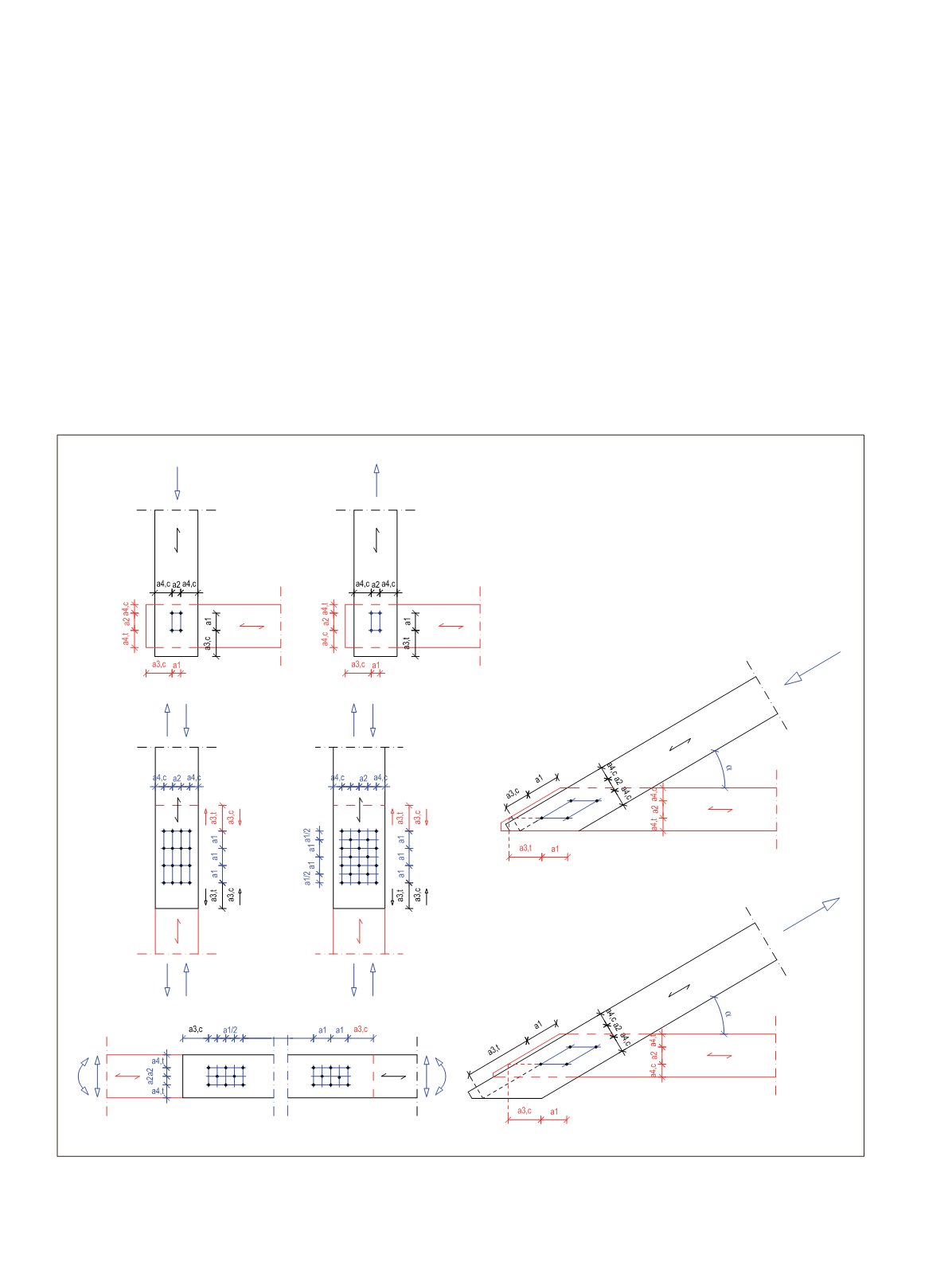
Figure 5.4.
Spacings (a
1
and a
2
), end distances (a
3
,t and a
3
,c) and edge distances (a
4
,t and a
4
,c) for fasteners
34
.
Figures 5.4–5.7 describe the spacings
a
1
,
a
2
, end distances
a
3,c
,
a
3,t
, edge distances
a
4,c
,
a
4,t
and angles α, β, and ε in differ-
ent cases of laterally loaded connections.. Their values for dif-
ferent faces of LVL-P and LVL-C products are given in:
• Table 5.1 for nails and screws with outer thread diameter <
12 mm
• Table 5.3. for bolts and screws with outer thread diameter
≥ 12 mm
• Table 5.4 for dowels
Figures 5.6–5.7 and Table 5.1 give the definitions and values for
axially loaded screw connections.
144
LVL Handbook Europe