



 145 / 228

5. STRUCTURAL DESIGN OF CONNECTIONS
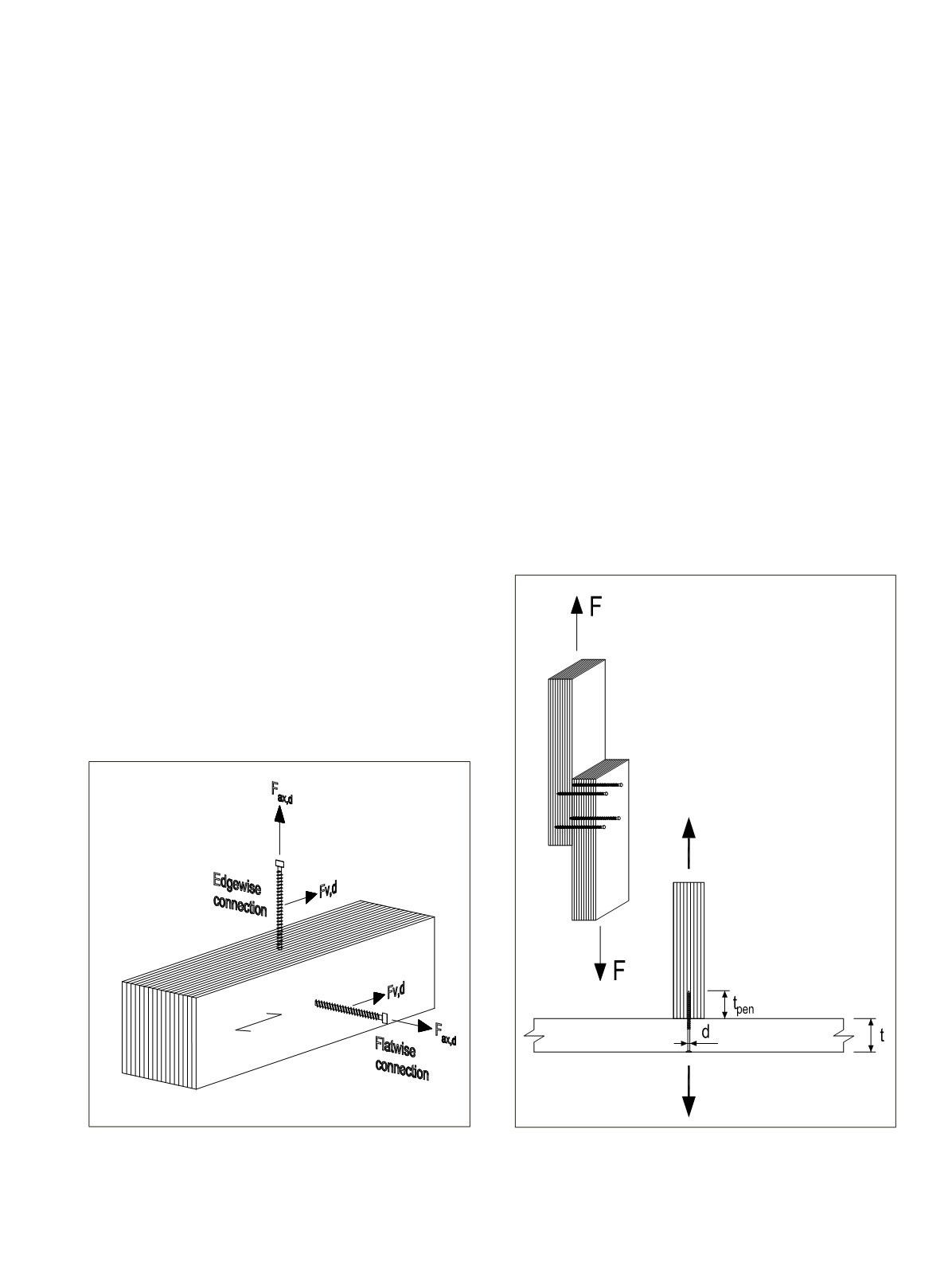
Figure 5.2.
Edgewise (edge face) and flatwise (wide face)
orientations and loading types of connections.
F
ax,d
are forces of
axially loaded and
F
v,d
are forces of laterally loaded connections
34
.
Figure 5.3.
A) Laterally loaded connection
34
B) Axially loaded
connection.
5.1 DESIGN OF LVL CONNECTIONS
ACCORDING TO EUROCODE 5
The design of connections with metal fasteners is specified in
Section 8 of Eurocode 5. However, the design instructions do
not fully cover LVL products. This section therefore provides
additional definitions for LVL based on the following docu-
ments:
• Design rules for LVL to Eurocode 5, Proposal for discussion
in CEN/TC250/SC5, Prof. Dr.-Ing. H.J. Blaβ and Dr. –Ing.M.
Flaig, Blaβ & Eberhart GmbH, 30.6.2017, CEN/TC250/SC5/
N0764
32
• Finnish Handbook for Eurocode 5 (RIL205-1:2017, Puurak-
enteiden suunnitteluohje)
31
• Connection chapters of Metsä Wood Kerto Manual
34, 35
The equations in this Section have individual numbers and
when an equation is in the same form in Eurocode 5, it is
marked with EC5 and the equation reference number there,
e.g., (EC5 8.2).
For the connection design of LVL members it is essential
to note that the behaviour of the product may differ depend-
ing on whether the connections are on the wide face (flatwise)
or on the edge face (edgewise) of the LVL, see Figure 5.2. The
edge face of LVL is more sensitive to splitting, which must be
taken into consideration when determining the geometry and
maximum fastener sizes of connections. LVL-C, on the other
hand, has the advantage of ductile behaviour of connections on
the wide face due to its cross veneers, thus eliminating a num-
ber of wood failure modes related to connections and enabling
denser groups of fasteners.
A connection may be laterally loaded, axially loaded, or
both laterally and axially loaded. For the determination of the
characteristic lateral load-carrying capacity of connections
with metal dowel-type fasteners, the contributions of the yield
strength, embedment strength, and withdrawal strength of the
fastener shall be considered. Section 8.2 of Eurocode 5 pro-
vides equations for calculating the characteristic load-carry-
ing capacity of nails, staples, bolts, dowels and screws for dif-
ferent failure modes according to the Johansen yield theory.
The minimum value, based on the relevant failure modes for
the connection type, should be taken as the capacity per shear
plane per fastener.
Fastener type specific instructions for calculating the em-
bedment strength
f
h,k
,yield moment
M
y,Rk
and axial withdraw-
al capacity
F
ax,Rk
, which are needed for the capacity calculation
of laterally and axially loaded connections, are defined in sec-
tions 8.3-8.7 of Eurocode 5. Alternatively, fastener suppliers
provide their own design instructions for connections using
their products in their ETA assessment documents.
A
B
LVL Handbook Europe
143