



 152 / 228

5. STRUCTURAL DESIGN OF CONNECTIONS
Design splitting capacity is calculated from the characteristic
splitting capacity according to equation (4.3), in subsection
4.1.6. For softwoods, the characteristic splitting capacity for
the arrangement shown in Figure 5.9 should be taken as:
F_(90,k)=14∙b√(h_e/((1 - h_e/h) )) [N]
(5.3) (EC5 8.4)
where
F
90,Rk
is the characteristic splitting capacity [Ν];
h
e
is the loaded edge distance to the centre of the most
distant fastener [mm];
h
is the timber member height, [mm]; and
b
is the member thickness, however, not more than
the penetration depth of the fasteners [mm].
Equation (5.3) does not need to be checked for wide face (flat-
wise) LVL-C connections since it is not sensitive to splitting
due to connection forces at an angle to the grain due to its
cross veneers.
5.3.2 Effective number of fasteners to
prevent splitting or row shear
An effective number of fasteners nef shall be used for bolt,
dowel and d > 12 mm screw connections at tension-loaded
ends of LVL members to prevent splitting or row shear failure
mode. For one row of ni fasteners parallel to the grain direc-
tion, the load-carrying capacity parallel to grain should be cal-
culated using the effective number of fasteners
n
ef
according
to the equation
31
:
n_ef=min{█(n_i@n_i^0,9 ∜((a ∙ t)/(50∙ 〖
(5.4)
where
n
i
is the number of fasteners in a row
i
;
d
is the effective diameter of the fastener,
for screws
d
ef
;
a={█(min(a_1;a_3 ),when n_i≥2@a_3,when n_i=1)┤ (5.5)
a
1
is the spacing of fasteners in the grain direction;
a
3
is the end distance of fasteners;
t={█(min(t_1;t_ connection with timber only in outer members
@min(
other two and multiple shear connection
(5.6)
t
1
and
t
2
are the thicknesses of outer timber members
(disregarded if the outer member is not timber);
and
t
s
is the thickness of the inner member of double shear
connections or the smallest thickness of the inner
member of a multiple shear connection.
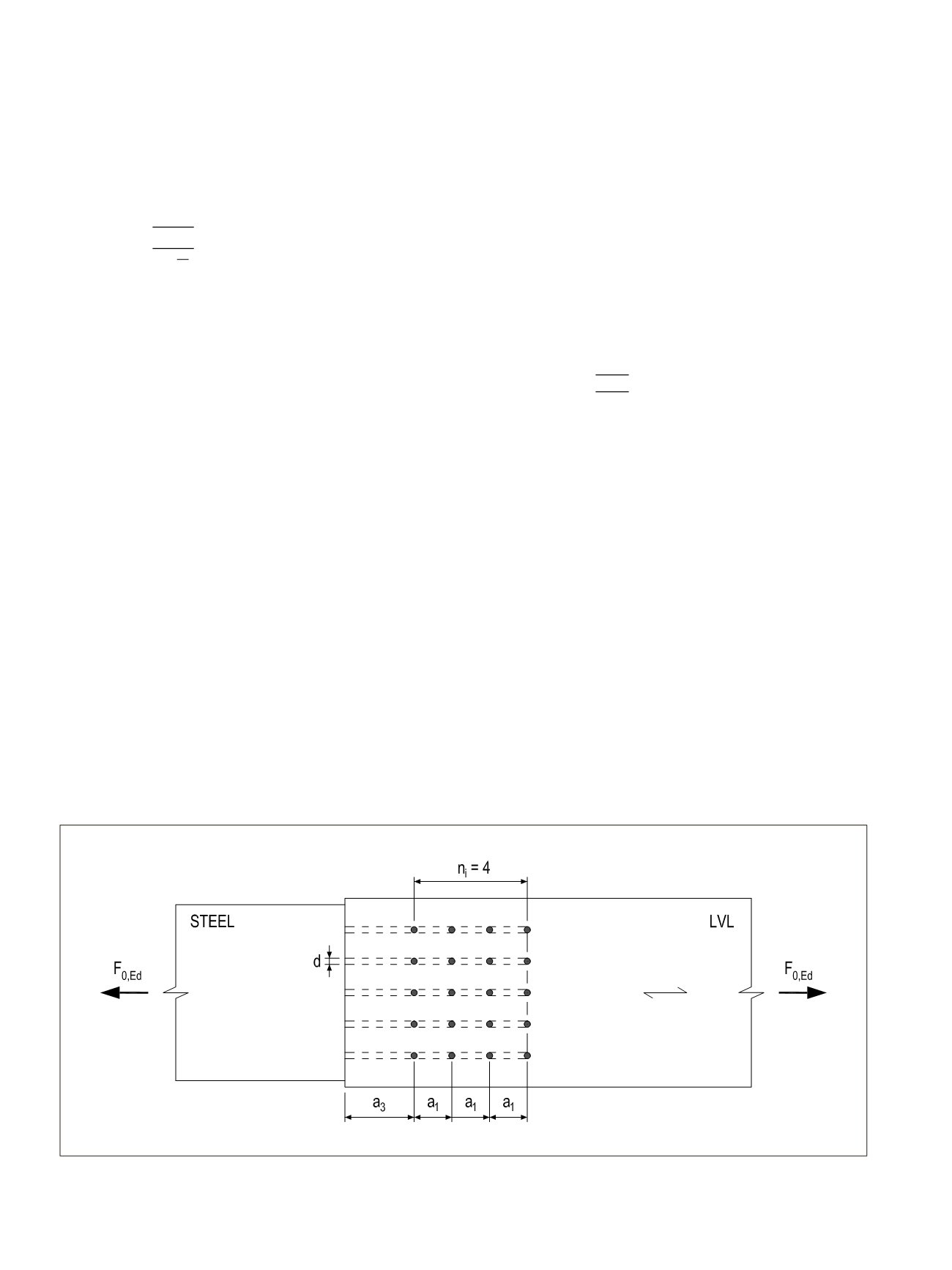
Figure 5.10.
Row shear failure mode.
Figure 5.8. Inclined force transmitted by a connection (
modified from
EC5 Figure 8.1).
(Kuva_107_a splitting force in connections 190314, Kuva_107_b splitting force
in connections 190314, Kuva_107_c splitting force in connections 190320)
Design splitting capacity is calculated from the characteristic splitting capacity according to
equation (4.3), in subsection 4.1.6. For softwoods, the characteristic splitting capacity for the
arrangem nt shown i Figure 5.8 should be t
s:
90,k
= 14 ∙ √
ℎ
e
(1 −
ℎ eℎ
)
[ ]
(5.3) (EC5 8.4)
where
F
90,Rk
is the characteristic splitting capacity [Ν
];
h
e
is the loaded edge distance to the centre of the most distant fastener [mm];
h
is the timber member height, [mm]; and
b
is the member thickness, however, not more than the penetration depth of the
fasteners [mm].
Equation (5.3) does not need to be checked for wide face (flatwise) LVL-C connections since
it is not sensitive to splitting due to connection forces at an angle to the grain due to its cross
veneers.
5.3.2
Effective number of fasteners to prevent splitting or row shear
An effective number of fasteners
n
ef
shall be used for bolt, dowel and d > 12 mm screw
connections at tension-loaded ends of LVL members to prevent splitting or row shear failure
mode. For one row of
n
i
fasteners parallel to the grain direction, the load-carrying capacity
parallel to grain should be calculated using the effective number of fasteners
n
ef
according to
the equation
31
:
ef
= min {
i
i 0,9
√
∙
50∙
2
4
(5.4)
where
n
i
is the number of fasteners in a row
i
;
d
is the effective diameter of the fastener, for screws
d
ef
;
ef
= min �
i
i 0,9
�
∙
50∙
2
4
= � min(
1
;
3
), when
i
≥ 2
3
, hen
i
= 1
ef
= min �
i
i 0,9
�
∙
50∙
2
4
= � min(
1
;
3
), when
i
≥ 2
3
, when
i
= 1
= � min(
1
;
2
) connection with timber only in outer members
min(2
1
; 2
2
;
s
) other two and multiple shear connection
150
LVL Handbook Europe