



 135 / 228

4. STRUCTURAL DESIGN OF LVL STRUCTURES
It is recommended to have the tapered edge on the com-
pressive side, especially for LVL-P, since the tension perpendic-
ular to grain strength
f
t,90,edge,k
is low, which can lead to cracks
and brittle failure. LVL-C may be used for special shapes, also
when the tapered edge is on the tensile side, as its
f
t,90,edge,k
is
higher due to the cross veneers and it behaves more ductile.
Figure 4.21 shows the
k
m,α
factors as a function of the angle
α
.
For high pitched roof beams (α ≥ ~10°) the maximum
shear stress
τ
v,max,d
and tension perpendicular to the grain
σ
90,max,d
shall be calculated at the point of the maximum bend-
ing moment stress with the equations:
τ_(v,max,d)=σ_(m,0,max,d)∙tanα
(4.55)
30
σ_(90,max,d)=σ_(m,0,max,d)∙tan^2 α
(4.56)
30
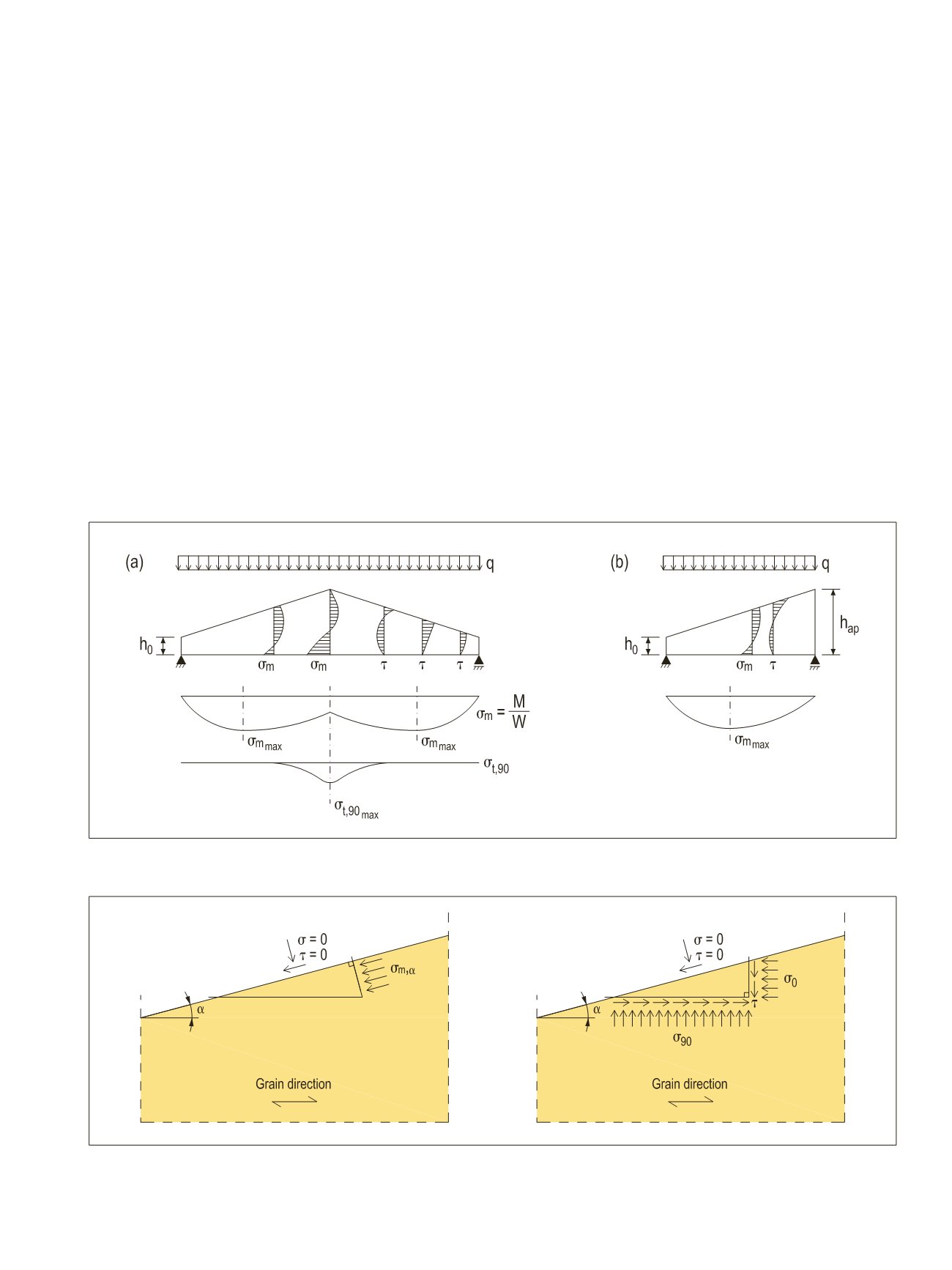
Figure 4.23.
Stress distributions in single and double-tapered beams. When the angle between loading and the grain is large (
α
≥ 10°), shear
stress at the point of maximum bending moment stress may become more critical than the shear stress at the support
30
.
Figure 4.24.
Stresses at the tapered edge of a beam: bending stress
σ
m,α
at the direction of the edge, bending stress at the grain direction
σ
0
,
shear stress
τ
=
σ
0
∙tanα and stress perpendicular to the grain
σ
90
=
σ
0
∙tan
2
α
30
.
For double-tapered, curved and pitched camber beams de-
sign instruction are given in Eurocode 5 clause 6.4.3. Addition-
al information to the clause:
• Factor
k
r
is 1,0 for LVL in the edgewise direction, as the shape
of the beam is cut directly from a panel and no reduction due
to bending of the laminates during production is needed.
•
k
m,α
is not used together with the equations for checking the
stresses at the apex point.
• It is not necessary to take kl into consideration in the resist-
ance against lateral torsional buckling of the beam (4.38).
v,max,d
=
m,0,max,d
∙ tan
(4.55)
30
90,max,d
=
m,0,max,d
∙ tan
2
(4.56)
30
v,max,d
=
m,0,max,d
∙ tan
(4.55)
30
90,max,d
=
m,0,max,d
∙ tan
2
(4.56)
30
LVL Handbook Europe
133