


 166 / 228

6. PERFORMANCE OF LVL IN FIRE
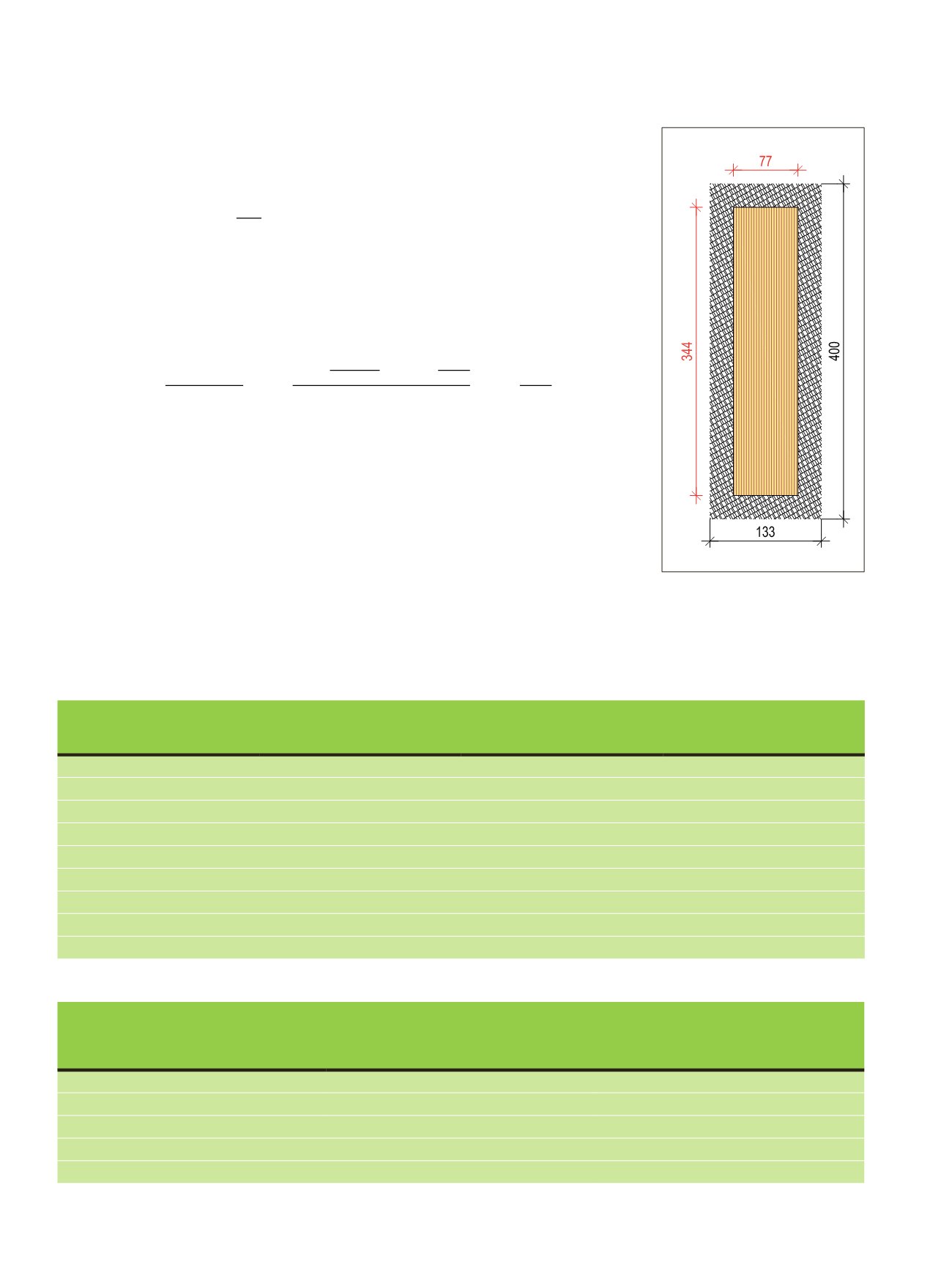
Figure 6.9.
Effective cross section
after 30 min fire exposure
Table 6.2.
Effective thickness of LVL 36 C panels after 15 - 60 min fire exposure on one side.
Table 6.3.
Minimum thickness of LVL 36 C panel to give a fire exposure protection time 30 - 90 minutes for an underlying wooden structure.
LVL 06, Table 6.2
LVL-C panel
Original thickness
[mm]
Effective thickness
after 15 min
[mm]
Effective thickness
after 30 min
[mm]
Effective thickness
after 60 min
[mm]
27
12
-
-
33
18
-
-
39
24
12
-
45
30
18
-
51
36
24
-
57
42
30
11
63
48
36
17
69
54
42
23
75
60
48
29
LVL 06, Table 6.3
Resistance to fire requirement R
[min]
Minimum thickness
h
p1
of
LVL 36 C panel protecting timber
frame assemblies
[mm]
Minimum thickness
h
p2
of
LVL 36 C panel protection applied
directly on beams or columns
[mm]
30
29
27
45
39
36
60
49
46
75
58
56
90
68
66
Example: 133x400 mm GLVL-P beam in 30 minutes fire ex-
posure on all sides:
d_ef=β_n∙t+k_0∙d_0=0,70 mm/min∙30min+1,0∙7mm=28mm
Size of the effective cross section:
Width b: 133 mm - 2∙28 mm = 77 mm
Height h: 400 mm - 2∙28 mm = 344 mm
Design value of bending strength for LVL-48 P:
f_(m,d,fi)=k_(mod,fi)∙(k_fi∙〖k_h∙f〗_(m,k))/γ_(M,fi)
=1,0∙(1,1∙(300mm/344mm)^0,15∙44 N/mm^2 )/1,0=47,4 N/
mm^2
When LVL-C panels are exposed to fire on one side, the
one-dimensional charring rate
β
0
is used for calculation of the
effective panel thicknesses. Table 6.2 shows the thicknesses af-
ter 15, 30 and 60min fire exposure. It is recommended that the
effective thickness has at least one cross veneer. The values are
thus shown for cases where the effective thickness is at least
9 mm.
ef
=
n
∙ +
0
∙
0
= 0,70 mmmin ∙ 30min + 1,0 ∙ 7mm = 28mm
m,d,fi
=
mod,fi
∙
fi
∙
h
∙
m,k M,fi
= 1,0 ∙ 1,1 ∙ � 300mm 344mm �
0,15
∙ 44 Nmm
2
1,0
= 47,4 Nmm
2
ef
=
n
∙ +
0
∙
0
= 0,70 mmmin ∙ 30min + 1,0 ∙ 7mm = 28mm
m,d,fi
=
mod,fi
∙
fi
∙
h
∙
m,k M,fi
= 1,0 ∙ 1,1 ∙ � 300mm 344mm �
0,15
∙ 44 Nmm
2
1,0
= 47,4 Nmm
2
164
LVL Handbook Europe