


 172 / 228

7. DURABILITY
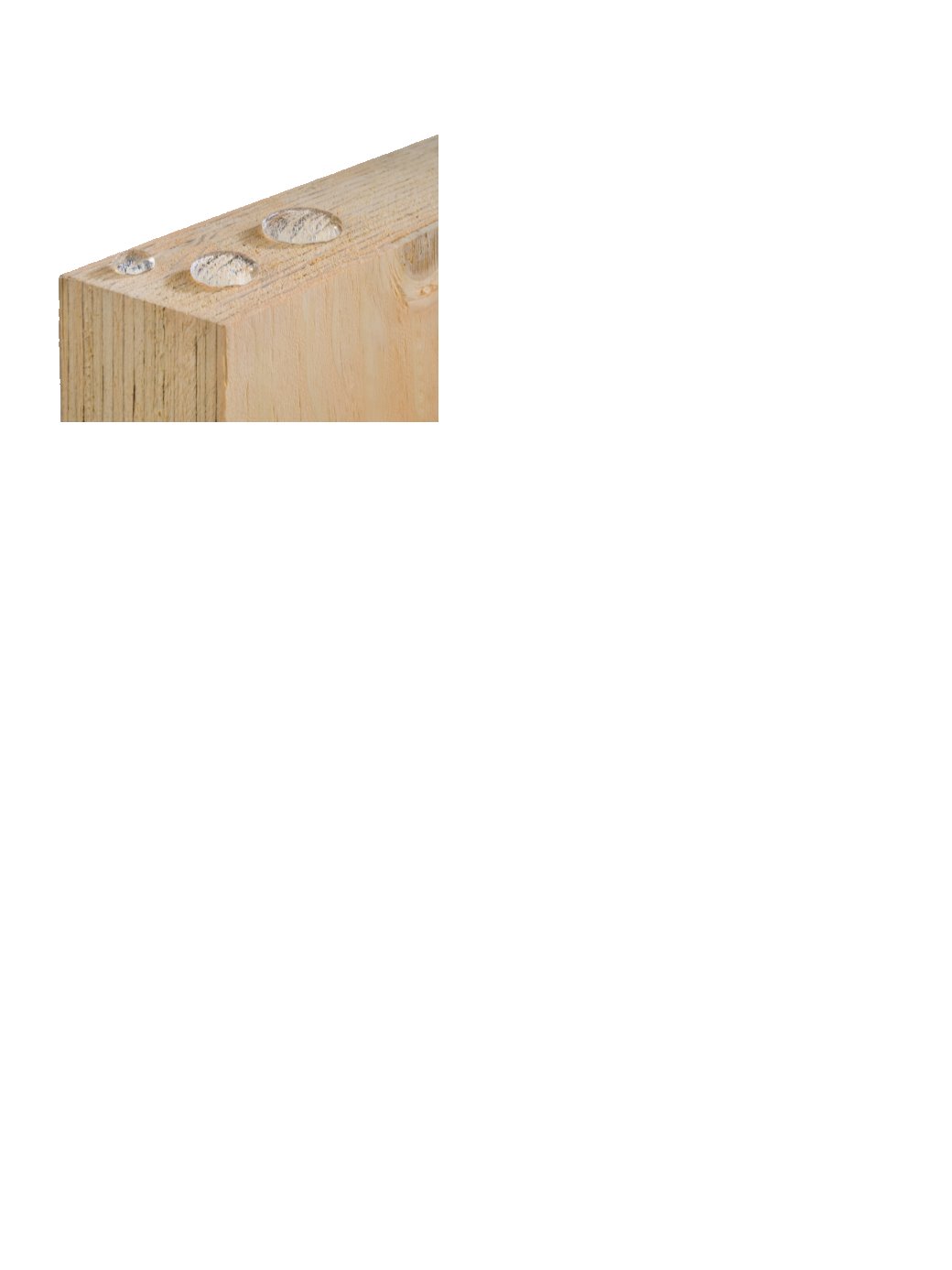
Figure 7.3.
Moisture protection treatment on LVL beams.
WeatherGuard® Metsä Wood
7.2.4 Discussion of durability class
definitions
The biological durability classification based on EN 350 is
poorly applicable to LVL or other engineered wood products.
The biological durability of LVL and other wood-based pan-
els (uncoated or overlaid) is dependent on the end use condi-
tions, and this is where the EN 335 use classes provide useful
guidance.
EN 350 durability classes are defined for the heartwood of
wood species in use class 4. However, there is no information
on the suitability of different natural durability classes for dif-
ferent end uses. CEN/TS 1099 gives guidance for plywood, but
does not provide information on the suitability of different nat-
ural durability classes for different end uses.
LVL and other wood-based panels contain sapwood. The
fact that sapwood is always regarded as non-durable argues
against using the EN 350 classification as, based on this, LVL
and all wood-based panels are universally classed as ‘not du-
rable’ (class 5).
EN 350 states that the durability classes are designed to in-
dicate the expected level of performance of wood when used
in contact with the ground (service conditions as described for
use class 4 in EN 335) and that in other use classes the service
conditions can result in wood performance that differs from
that implied by the durability classification. Based on this, the
standard may not be directly applicable to use class 3, 2 and 1
conditions and should therefore not be used as the biological
durability criteria. The natural durability of LVL can differ from
that of the wood species used in its manufacture. Additional
factors contributing to durability include the thickness of the
plies, the structure of the board, and the characteristics and
quantity of the binder.
In conclusion, it is recommended to declare the product as
durable in use class 1 and 2 (or service class 1 and 2 according
to EN1995-1-1) conditions.
7.3 STRUCTURAL WOOD PROTECTION
The best way to manage the durability of LVL, as well as all
other timber structures, is structural protection. This means,
for example, long enough roof overhangs and high foundation
levels and moisture isolation between the foundation and sole
plates. Structural protection keeps the structures in service
class 2 (use class 2) or dryer conditions, which wood products
can resist well.
7.3.1 Resistance against temporary moisture
exposure of structural LVL products
Exposure to rain, splashing as well as water convection from
other structures shall be avoided. The designer must pay atten-
tion to the details of the construction to ensure that no water
pockets will be formed. The product may be exposed to weath-
er for a short period during installation. During the erection
of a building, structural LVL products and elements, which are
structurally glued from LVL components, have good resistance
to temporary exposure to water without damage or decay. This
requires, however, that it is ensured that the products can after-
wards dry to the desired moisture content before the structural
envelope is closed. The integrity of the glue bonding is main-
tained according to the assigned service class throughout the
expected life of the structure
28
.
LVL products swell when the moisture content increases, and
shrink when the moisture content decreases. A part of the swell-
ing is permanent and the extent of these dimensional chang-
es depends on the grain direction. Wetting can cause perma-
nent deformations and impair the visual appearance of surface
veneers, such as colour changes due to water staining, surface
cracks and falling knots due to drying shrinkage after wetting
28
.
Joints with mechanical connectors, such as bolted connec-
tions, may become loose due to swelling and shrinking cycles.
Drying shrinkage after severe wetting may cause cracking,
which often reduces the load-bearing capacity of dowel-type
connections, notched beams and beams with holes.
7.3.2 Resistance against UV radiation
Like all wood products, non-treated surfaces of LVL will slow-
ly fade to grey due to the action of UV radiation from the sun.
This greying does not affect the strength properties.
If this natural greying is not desired, an adequately pigment-
ed coating system or a coating containing special additives
must be applied. The higher the proportion of pigments, the
greater the protective effect. The coating layer must be of suffi-
cient thickness to fulfil the minimum protection requirement
across the entire surface. More information is provided in the
technical data sheets of the coating manufacturers
42
.
7.3.3 Chemical durability
The main components of wood: cellulose and lignin, react
in opposite ways to acids and alkalinity. Cellulose is not very
170
LVL Handbook Europe