



 177 / 228

8. BUILDING PHYSICS
Table 8.1.
Swelling and shrinkage factor αH for LVL products in %
per 1% change in moisture content below fibre saturation point.
Note: due to its cross band veneers, LVL-C undergoes much less
dimensional change in the width direction than LVL-P (FprEN
14374:2018).
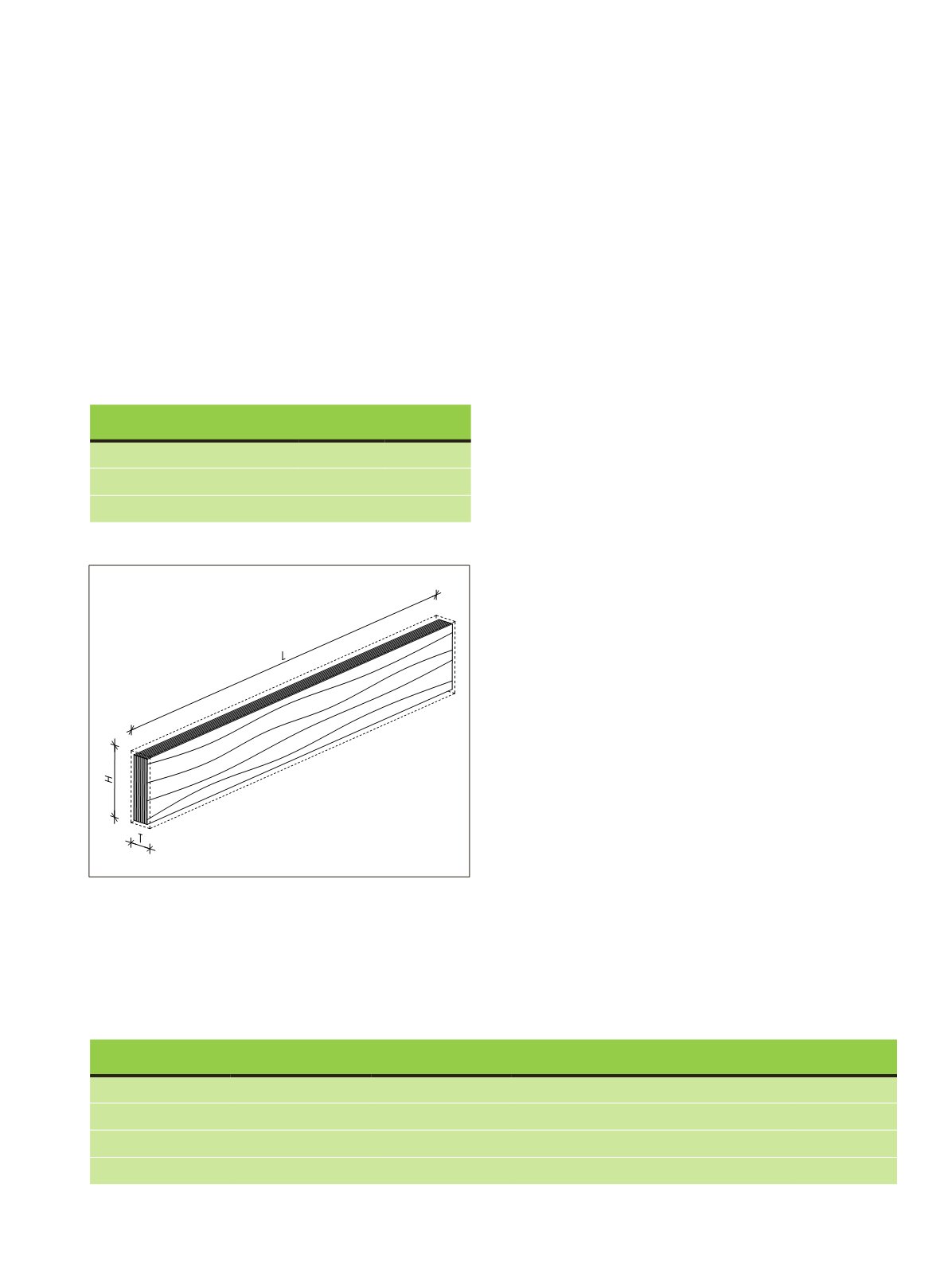
Figure 8.3.
Directions of LVL dimensions
Table 8.2.
Example of dimensional changes due to moisture : If the relative humidity changes from 50% to 85%, the moisture content of a LVL
beam increases by approximately 7%. The resulting effect on beam dimensions is as follows:
8.1.3 Dimensional changes due to moisture
LVL products are delivered from the factory at a moisture con-
tent that is close to the moisture content of a service class 1 end
use. This is an advantage, as it significantly reduces dimension-
al changes due tomoisture, provided that the members are pro-
tected against weather exposure during transport, storage and
construction work.
LVL 08, Table 8.1
Dimension
LVL-P
LVL-C
Thickness
t
0,32
0,32
Height
h
(or width of a panel)
0,32
0,03
Length
l
0,01
0,01
LVL 08, Table 8.2
Product
Direction
Original dimension Dimension after +7% increase of MC
Difference
LVL-P or LVL-C
Length
l
4200 mm
4200 + (7 × 0.01/100 × 4200) = 4203 mm +3,0 mm
LVL-P or LVL-C
Thickness
t
57 mm
57 + (7 × 0.032/100 × 57) = 58,3 mm
+1,3 mm
LVL-P
Height
h
260 mm
260 + (7 × 0.32/100 × 260) = 266 mm
+6,0 mm
LVL-C
Height
h
260 mm
260 + (7 × 0.03/100 × 260) = 260,6 mm
+0,6 mm
LVL products swell when their moisture content increases
and shrink when their moisture content decreases. The extent
of these dimensional changes depends on the grain direction.
Due to the hot press production process, a proportion of the
swelling in the thickness direction occurring upon first wetting
of the product is permanent. However, despite the dimensional
changes due to moisture, the nominal thickness of the prod-
uct should be used in the structural capacity design of LVL
members.
Dimensional change ΔL due to variation in moisture can
be calculated as follows:
∆
L
= ∆
ω
∙
α
H
/100 ∙
L
(8.2)
where
Δ
ω
is the change in product moisture content [%];
α
H
is the product’s dimensional variation coefficient, see
Table 8.1 for values and Figure 8.3 for directions; and
L
is the product dimension in the corresponding direction.
Notably, due to its cross band veneers LVL-C has a very
low
α
H
factor in the member width direction: only 10% of the
value specified for LVL-P products. This advantage can be uti-
lized in structures that are sensitive to dimensional changes
due to moisture.
LVL products can warp if the moisture content of oppo-
site surfaces is not equal, for example if one surface is exposed
to a higher relative humidity than the other. LVL-P products
are more sensitive to such warping than LVL-C, especially if
the height of the product is more than 8 times the thickness
(h > 8t). Therefore, it is normally recommended to limit the
slenderness of the LVL-P beams to this ratio. If careful mois-
ture management of the components and structures can be as-
sured throughout the logistic chain and construction process,
e.g. in off-site element production, a h/t ratio of max ~12 may
be considered.
LVL Handbook Europe
175