



 181 / 228

9. CALCULATION EXAMPLES OF LVL STRUCTURES
These structural calculation examples for LVL are based on Eurocodes (EN1990, EN1991 and EN1995) and
the additional instructions given in Chapters 4-5. Where information from National annexes is required, the
Finnish annex or the default values of Eurocodes have been used. The calculations make references to the
equation numbers of the Chapters 4 - 6. The examples are chosen to demonstrate the calculations methods.
Therefore some of the component sizes may not necessarily ideal for practice and those cases have comments
of possibly better suitable sizes at the end of each example.
9.1 LVL 48P JOIST FLOOR
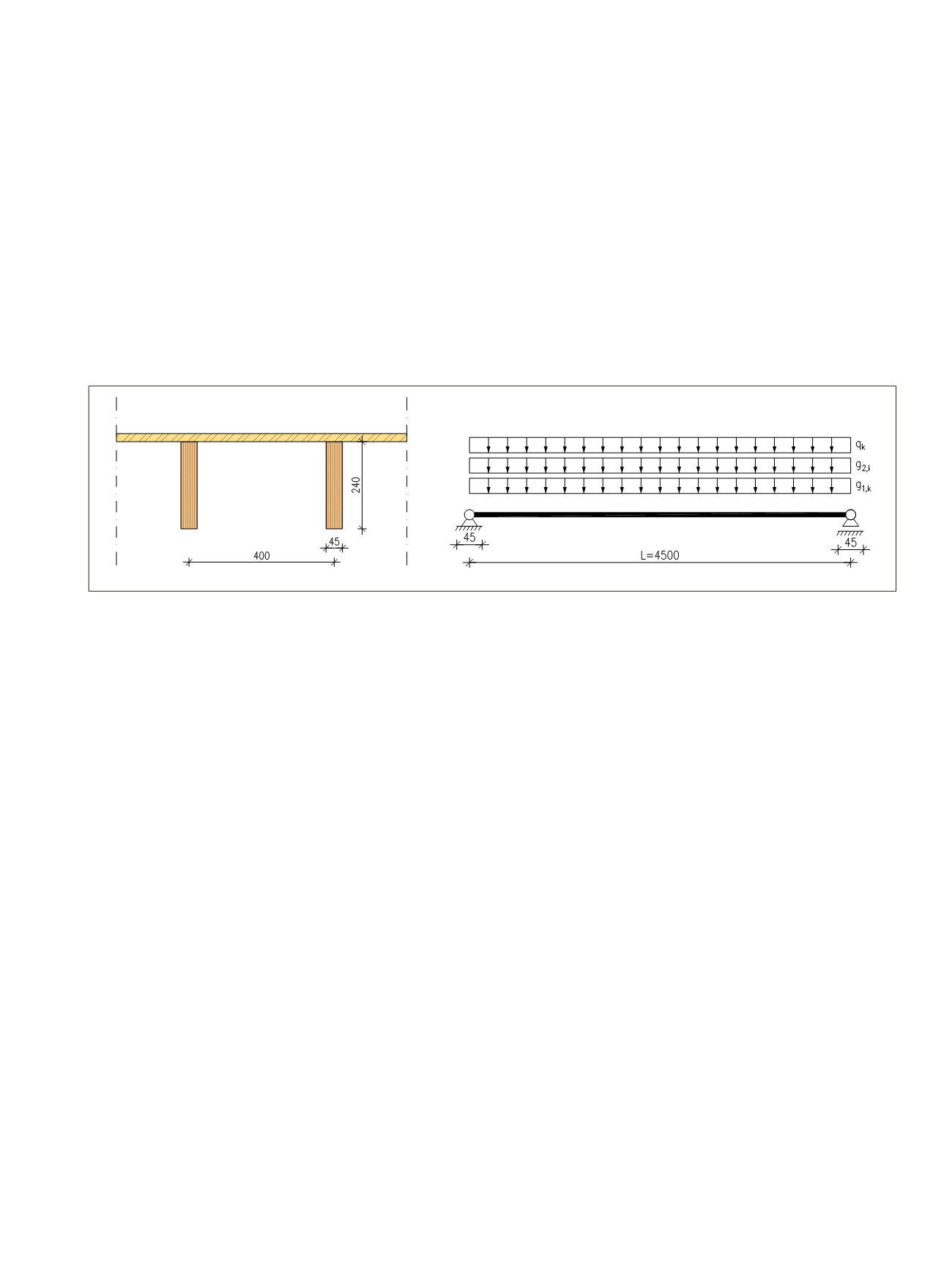
Residential floor: span
L
= 4500 mm; width
b
= 5000 mm; 45x240 mm LVL 48P joists at spacing
s
= 400 mm;
22 mm chipboard decking. Support length 45 mm. Live load
q
k
= 2,0kN/m
2
; partition load
g
2,k
= 0,3 kN/m
2
and self-weight
g
1,k
= 0,6 kN/m
2
. Service class SC1.
Joist properties:
Bending strength edgewise
f
m,0,edge,k
= 48 N/mm
2
Shear strength edgewise
f
v,0,edge,k
= 4,2 N/mm
2
Compression perpendicular to the grain edgewise
f
c,90,edge,k
= 6 N/mm
2
Modulus of elasticity
E
0,mean
= 13800 N/mm
2
Modulus of rigidity
G
0,edge,mean
= 600 N/mm
2
Area of cross section
A
=
b∙h
= 10800 mm
2
Section modulus
W
=
b∙h
2
/6
= 4,32∙10
5
mm
3
Moment of inertia
I
=
b∙h
3
/12
= 5,18∙10
7
mm
4
Moment stiffness of the joist
EI
= 13800 N/mm
2
∙ 5,18∙10
7
mm
4
= 7,15∙10
11
Nmm
2
Shear rigidity of the joist
GA
= 600 N/mm
2
∙ 10800 mm
2
= 6,48∙10
6
N
Modification factor kmod for medium-term, SC1
= 0,8
Modification factor kdef for SC1
= 0,6
Material safety factor
γ
M
(default value in EC5)
= 1,2
Size effect factor
k
h
= (300/240)
0,15
= 1,034
Loading combinations
The most critical ultimate limit state (ULS) load combination:
E_(d,ULS) = γ_G∙(g_(1,k)+g_(2,k))+ γ_Q∙q_k
(4.1)
E_(d,ULS) =1,15∙(0,6 kN/m^2+0,3 kN/m^2 )+1,5∙2,0 kN/m^2
E_(d,ULS)= 4,03 kN/m^2
Note: Safety factors
γ
G
and
γ
Q
are according to Finnish National annex of Eurocode 0.
The most critical serviceability limit state (SLS) load combination:
E_(d,SLS) = γ_G∙(g_(1,k)+g_(2,k))+ γ_G∙q_k
(4.1)
E_(d,SLS) =1,0∙(0,6 kN/m^2+0,3 kN/m^2 )+1,0∙2,0 kN/m^2
E_(d,SLS)= 2,9 kN/m^2
d,ULS
=
G
∙ (
1,k
+
2,k
) +
Q
∙
k
(4.1)
d,ULS
= 1,15 ∙ (0,6 kN/m
2
+ 0,3 kN/m
2
) + 1,5 ∙ 2,0 kN/m
2
d,ULS
= 4,03 kN/m
2
d,SLS
=
G
∙ (
1,k
+
2,k
) +
G
∙
k
(4.1)
d,SLS
= 1,0 ∙ (0,6 kN/m
2
+ 0,3 kN/m
2
) + 1,0 ∙ 2,0 kN/m
2
d,SLS
= 2,9 kN/m
2
d,ULS
=
G
∙ (
1,k
+
2,k
) +
Q
∙
k
(4.1)
d,ULS
= 1,15 ∙ (0,6 kN/m
2
+ 0,3 kN/m
2
) + 1,5 ∙ 2,0 kN/m
2
d,ULS
= 4,03 kN/m
2
d,SLS
=
G
∙ (
1,k
+
2,k
) +
G
∙
k
(4.1)
d,SLS
= 1,0 ∙ (0,6 kN/m
2
+ 0,3 kN/m
2
) + 1,0 ∙ 2,0 kN/m
2
d,SLS
= 2,9 kN/m
2
LVL Handbook Europe
179