


 173 / 228

7. DURABILITY
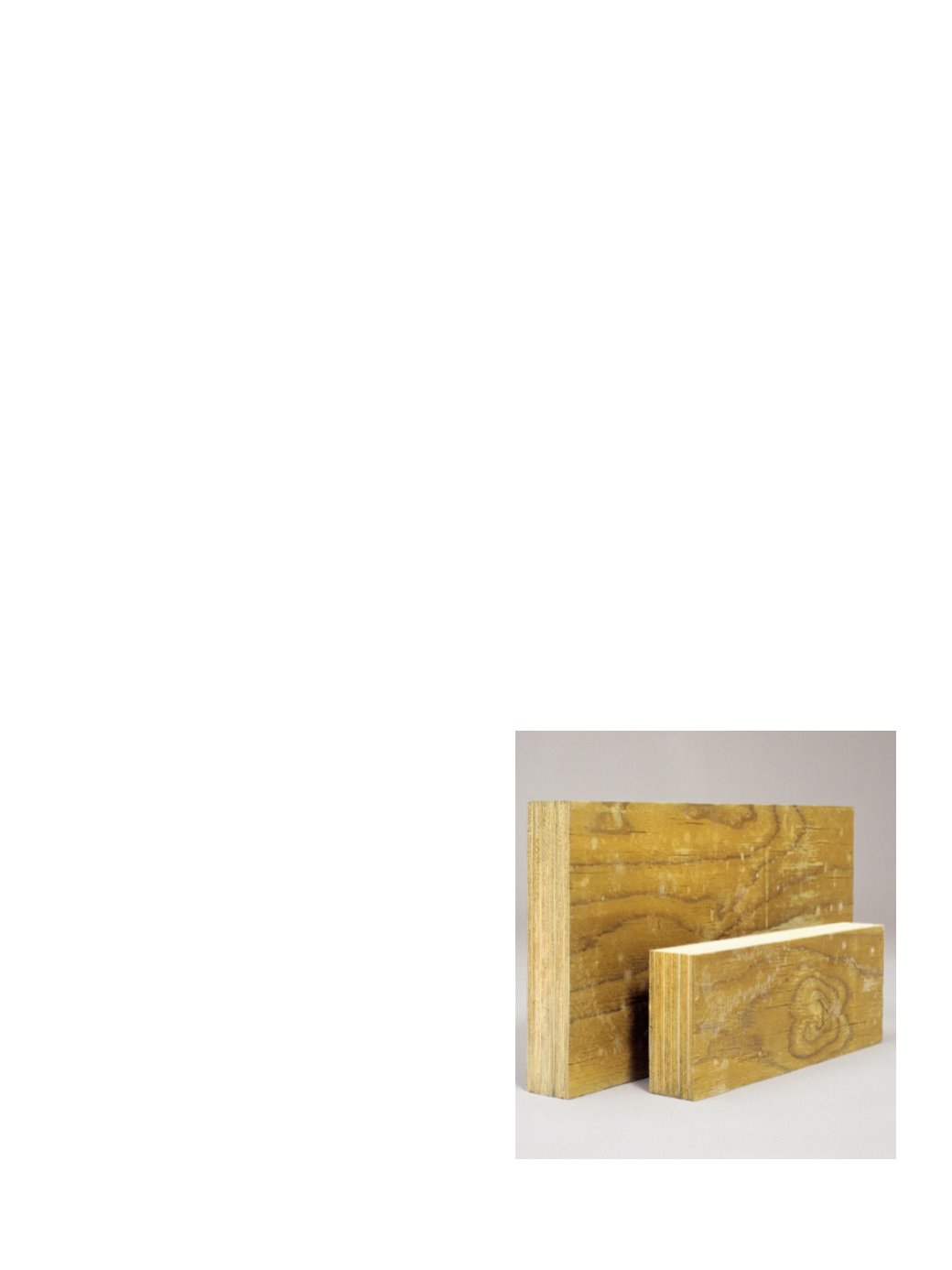
Figure 7.4.
Pressure-impregnated LVL-C beams.
resistant to strong acids, but its resistance to bases is good.
Lignin, on the other hand, is easily dissolved in bases, whereas
it is resistant to most strong acids. For these reasons, wood is
quite resistant to moderate chemical effects.
LVL has good resistance to mild acids and acid salt solutions.
Alkalis, however, cause softening of the wood. Direct contact
with oxidizing agents such as chlorine, hypochlorites and ni-
trates should be avoided.
Wood is generally quite resistant to organic substances.
However, organic solvents such as acetone, benzene, alcohol
etc. dissolve resins, fats and waxes, causing similar effects to
water, i.e., producing swelling and a slight reduction in strength
properties. Petroleum oils have no effect on strength properties
but cause discolouration.
Chemical resistance can be improved with various types of
coatings
42
.
7.4 CHEMICAL WOOD PROTECTION
7.4.1 Surface treatment
LVL can be protected against temporary weather exposure by
surface treatments that repel rainwater, and therefore reduce
the amount of moisture absorbed by the product, but allowwa-
ter vapour movement to and from the product. This improves
dimensional stability and reduces swelling of the treated LVL
product during the construction time.
Use in high relative humidity conditions may result inmould
growth on the surface of structural LVL products. If the prod-
ucts are exposed to outdoor air humidity conditions (e.g. struc-
tures in unheated spaces) or wetting during the logistic chain
and construction time, a brushable or sprayable treatment
should be applied on the surface of the LVL components to
reduce the risk of mould growth. In some cases LVL compo-
nents are treated at the factory, but the default practice is for
treatment to be done during offsite production of timber ele-
ments or on the construction site. If there is mould growth on
the surface of LVL products, the mould must be removed, e.g.
by sanding, before closing the structure.
The surface treatments do not affect the product’s strength
properties, but their compatibility with end finishes, such as
paints, shall be verified separately
28, 43
.
7.4.2 Pressure impregnation
Pressure impregnation of spruce softwood LVL is possible
when the impregnation process is tailored for it. Due to di-
mensional changes due to moisture and to achieve the required
retention level of the water-based impregnation agent, it is rec-
ommended to use only LVL-C for impregnation. For beam-size
products with a width of max 600 mm, a retention level similar
to the AB class used in the Nordic countries can be achieved.
It is also possible to impregnate panel-size products, although
the retention level in the core area is lower.
Applications for pressure-impregnated LVL-C include terrace
and balcony structures, balustrades, stairs and piers where the
products are not in direct ground contact (= Use class 3.1 con-
ditions).
AB class impregnation agents are aggressively corrosive and
therefore only stainless steel connectors should be used in
structures made of impregnated LVL.
The surface of pressure-impregnated LVL is rougher than
regular LVL. The impregnation and drying processes cause
swelling and shrinkage, which open some of the peeling cracks
in the surface veneers. Local cracking around knots and minor
separation of scarf joints in small areas of the surface veneer
might occur.
Impregnated LVL products swell in the process and their
equilibrium moisture content and specific weight are a cou-
ple of per cent higher than untreated products. The increased
weight shall be taken into account, but otherwise structural
design shall be made with the nominal dimensions of the prod-
uct with the strength and stiffness reduction factors according
to service class 3 of Eurocode 5. In some countries additional
reduction factors given by their national requirements shall be
taken into account
44
.
LVL Handbook Europe
171