


 171 / 228

7. DURABILITY
7.1 SERVICE LIFE OF WOODEN
BUILDINGS AND LVL STRUCTURES
Buildings are normally designed for a 50-year service life.
When structural LVL is produced and tested according to its
harmonized product standard EN14374, the durability of the
adhesive bonding strength and the mechanical properties meet
the requirements of the design service life. However, the struc-
tural protection of the building shall be designed, executed and
maintained so that the structures remain in service class 1 or
2 conditions.
In remarkable buildings, the design service life is 100 years.
This can be achievedwith the samemeans as the default 50-year
service life, but an increased safety factor for the design values
of eventual climatic loads (wind and snow load) shall be used
in the structural design. The safety factor is defined in national
regulations, e.g. in Finland the design values of eventual cli-
matic loads must be increased by factor 1,2 when the expected
service life is above 100 years.
The report 100 years’ service life of wood in service class
1 and 2 – dry and moderately humid conditions, Viitanen,
VTT-R-04689-14
41
summarizes that to achieve a 100-year ser-
vice life the following should be ensured: use of dry and CE-
marked wood material; use of correct glue type and glue class
for engineering components; good detailing and design; good
execution and protection against weathering, take into account
the effect of natural loading; proper maintenance and provision
of a maintenance manual for users; and guarantee proper con-
ditions for materials in the building throughout its service life.
7.2 DURABILITY CLASSIFICATIONS OF
STRUCTURAL LVL PRODUCTS
7.2.1 Durability of adhesive bonding
strength of structural LVL
The adhesive and glue bond used for structural laminated ve-
neer lumber (LVL) is suitable for service classes 1, 2 and 3 ac-
cording to EN 1995-1-1:2004 (Eurocode 5). This is verified in
a cleavage test defined in EN 14374:2004, Annex B. The test
procedure for LVL specimens is as follows:
• Immersion for at least 4 h in boiling water
• Drying in a ventilated oven for at least 16h at 60°C
• Immersion for at least 4 h in boiling water again
• Cooling in room temperature water for at least 2h.
• After the boiling & drying cycles, the samples are cleaved at
least at one glue line close to the middle of the thickness and
the apparent cohesive wood failure percentage is determined
according to EN 314-1.
• For each tested glue line the apparent cohesive wood failure
percentage shall be at least 70%.
Adhesive type I (full exposure to the weather) according to
EN 301 or EN 15425 (polyurethane adhesives) shall be used
for structurally glued products are made from structural LVL
components.
7.2.2 Biological durability of softwood LVL
LVL veneers always contain some sapwood. According to EN
350 sapwood is regarded as not durable unless otherwise prov-
en by test data. The biological durability class of softwood LVL
is therefore DC 5 (Not durable) according to this classification.
7.2.3 Structural LVL’s suitability for
different use classes and service classes
Structural LVL products can be used in service classes 1 and 2
as defined in Eurocode 5, which corresponds to the use classes
1 and 2 as defined in EN 335. Structural LVL products should
not be used in service class 3 without additional protective
treatment. Structurally glued products made from LVL com-
ponents are not suitable for service class 3.
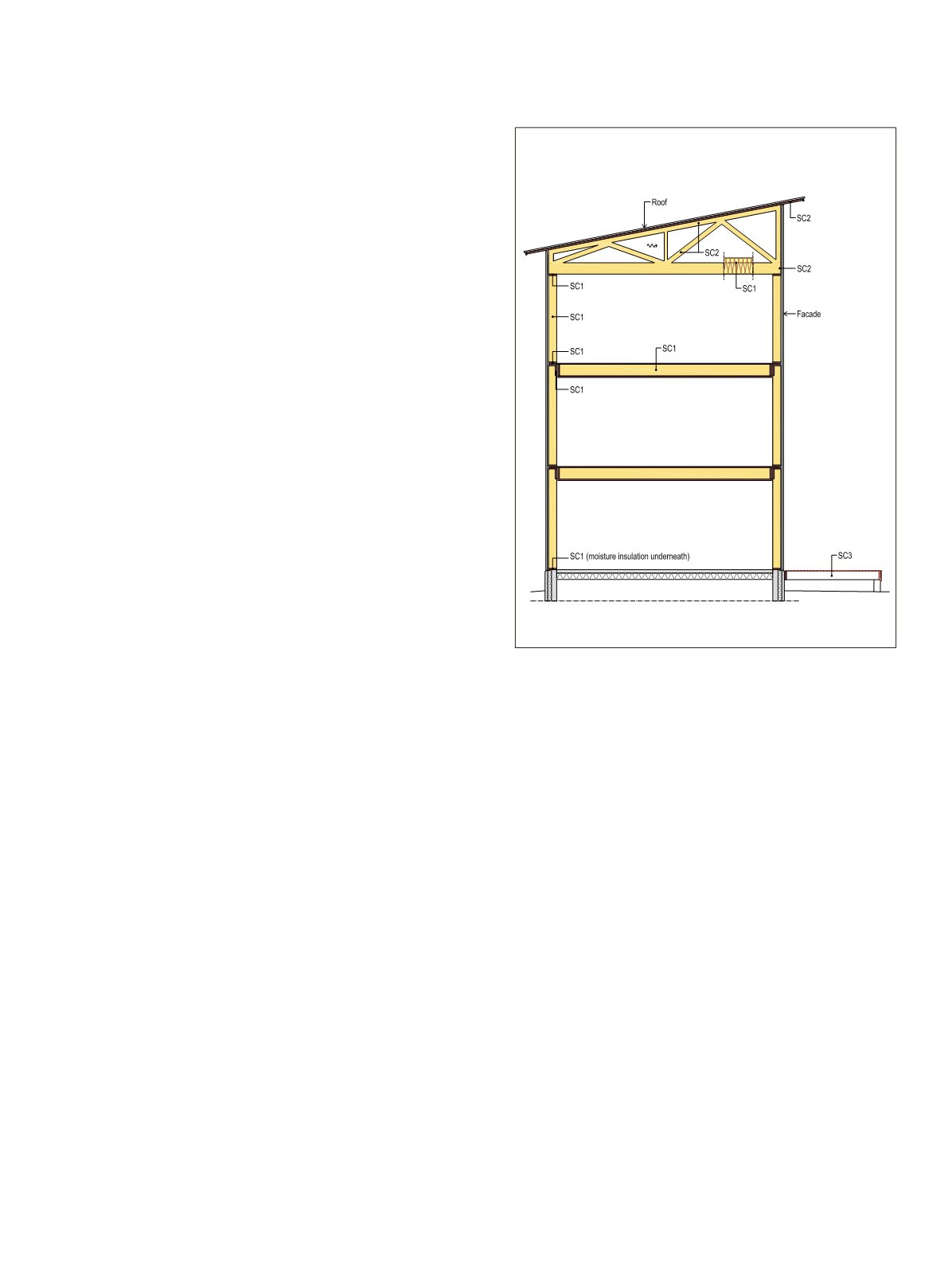
Figure 7.2.
Roof overhangs and high foundation level are practical
means of structural wood protection to keep wooden structures in
service class 2 (use class 2) or dryer conditions. Note: Assignment of
structures to service classes may be given in the National Annex to
EN1995-1-1 for each country.
LVL Handbook Europe
169