



 161 / 228

6. PERFORMANCE OF LVL IN FIRE
6.1 WOOD AND FIRE
Wood and wood products, including LVL, are combustible ma-
terials. They start to burn at the surface at a temperature of 270
°C when exposed to flame. However, self-ignition does not oc-
cur at temperatures below 400 °C. According to structural fire
design part of Eurocode 5 (EN1995-1-2), the start of charring
is defined as the point at which the temperature of timber sur-
face reaches 300 °C.
The resistance to fire behaviour of wood products is highly
predictable and can be calculated according to the structural
fire design specifications of Eurocode 5. Burning creates a char
layer on the surface of wood products. The char layer acts as an
insulation layer, which slows the burning and protects the rest
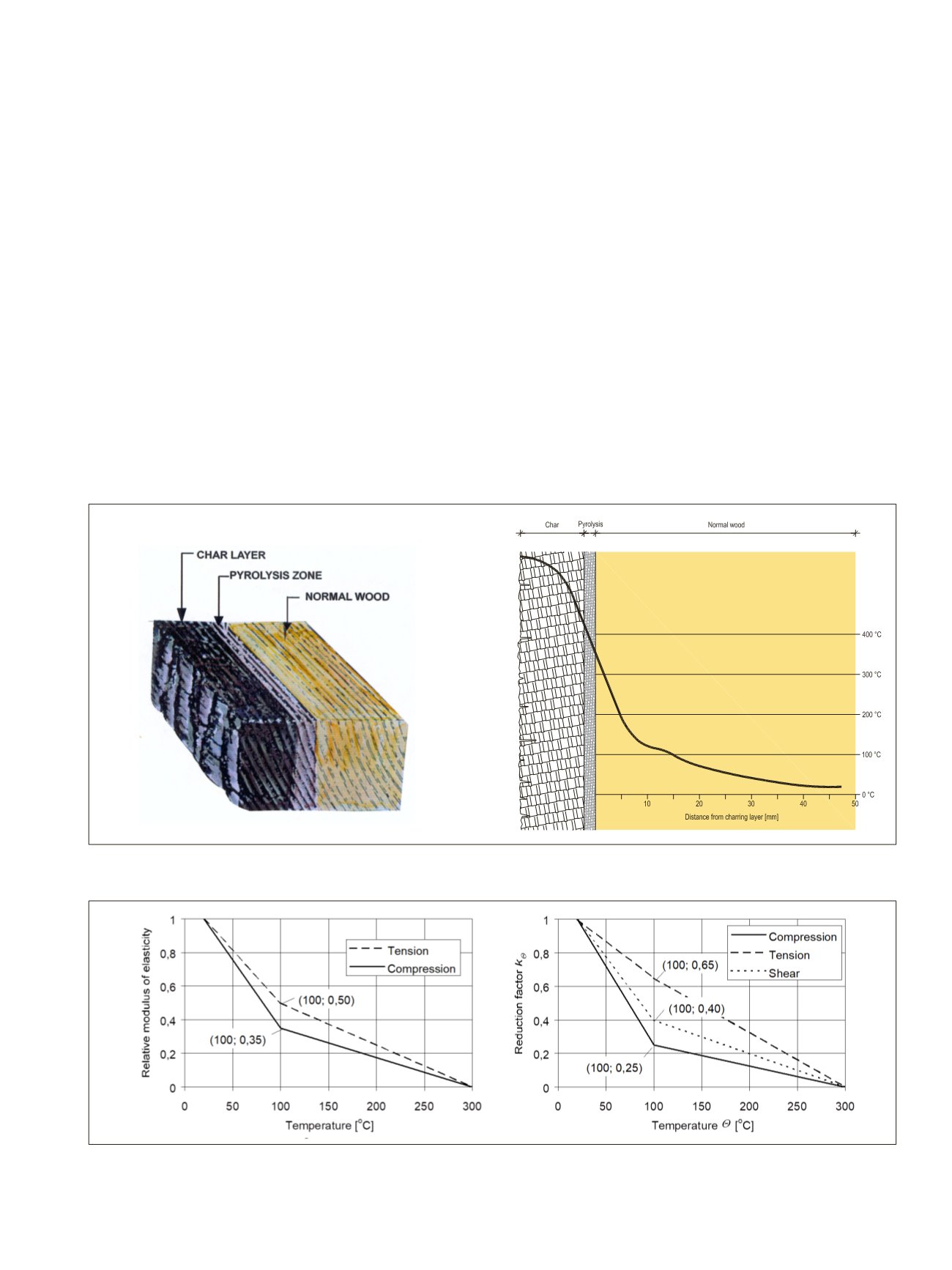
of the cross section, see Figure 6.2. However, the high temper-
ature prior to burning reduces the strength and stiffness prop-
erties of the wood even before charring, see Figure 6.3, which
must be taken into account in structural fire design.
Figure 6.3.
Influence of temperature on the mechanical properties of softwood. Left: Reduction of modulus of elasticity parallel to grain, Right:
Reduction of strength parallel to grain (EN1995-1-2:2004, Figure B.4 and B.5).
Figure 6.2.
Temperature gradient in burning wood. The temperature drops significantly behind the charring layer. 15 mm from the charring
zone the temperature is below 100 °C
36
.
(Schaffer, FPL, US 1967 and Brandsäkra trähus 3, SP Trä, Sweden 2012)
Reaction to fire requirements are specified for wood sur-
faces to control the risk of flame spread in buildings. They
set boundary conditions for the use of visible wood in clad-
dings and structures. In some cases fire retardant treatments
or sprinkler systems can allow more visible wood structures to
be used in architectural design.
6.2 REACTION TO FIRE
In the European classification system defined in EN 13501-
1, the reaction to fire performance class of LVL is D-s2, d0.
This class can be applied to LVL without further testing when
the density is at least 400 kg/m
3
and the product thickness is
≥ 18 mm (European Commission Delegated Regulation (EU)
2017/2293)
37
.
LVL Handbook Europe
159