



 117 / 228

4. STRUCTURAL DESIGN OF LVL STRUCTURES
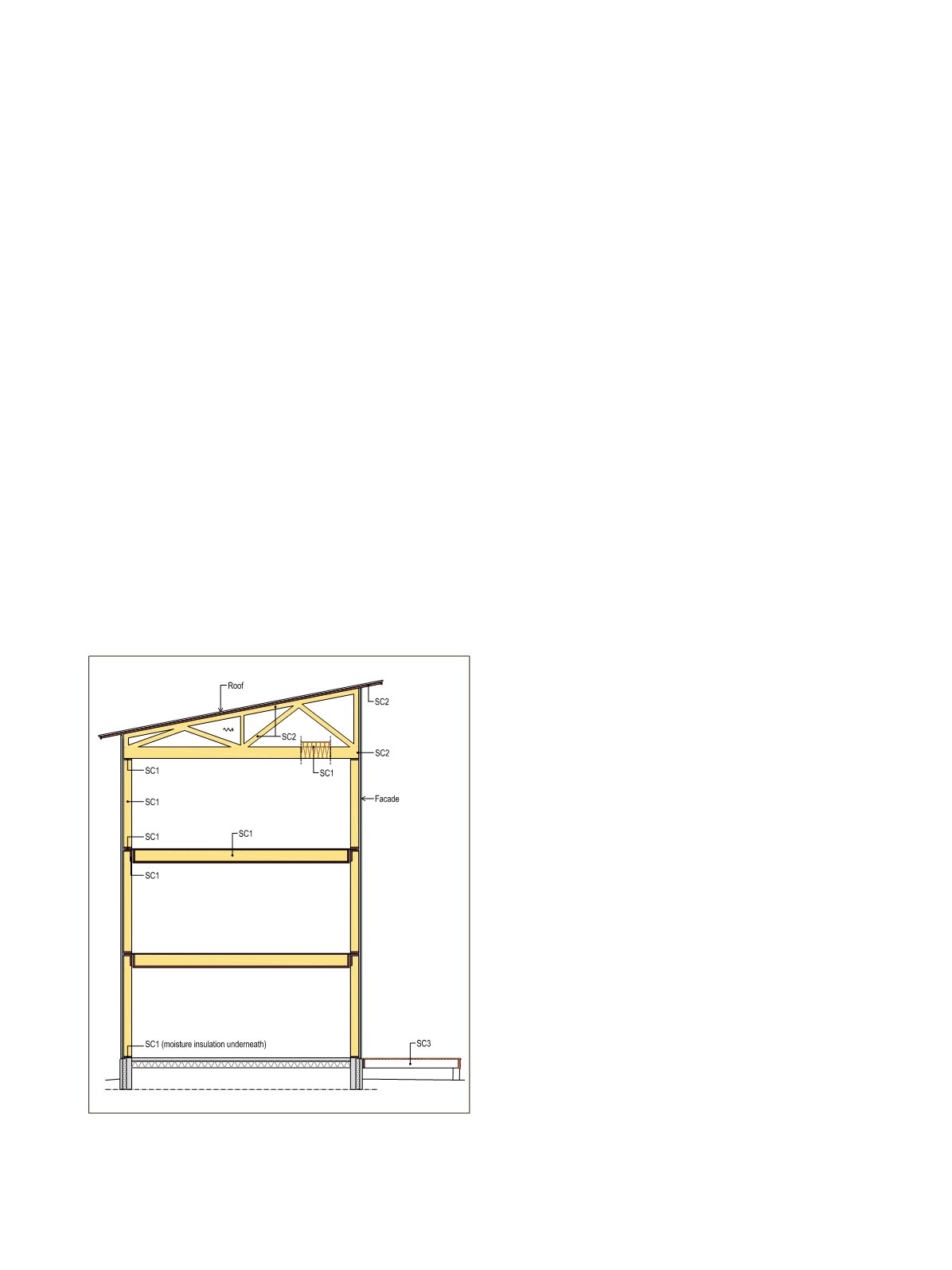
Figure 4.2.
Examples of service class 1 (SC1), 2 (SC2) and 3 (SC3)
conditions in wooden structures. Note: Assignment of structures
to service classes are given in the National Annex to Eurocode 5 for
each country.
4.1.3 Load duration
In the Eurocodes, load-duration classes are characterized by
the effect of a constant load acting for a certain period of time
in the life of the structure. For a variable action, the appropri-
ate class is determined on the basis of an estimate of the typical
variation of the load with time, see Table 4.1.
4.1.4 Service classes
Moisture content and changing humidity conditions have a sig-
nificant influence on the strength and stiffness properties of
LVL as well as on other wood-based materials. In Eurocode 5
this is taken into account by defining 3 service classes:
• Service class 1 (SC1)
is characterized by a moisture content
of the materials corresponding to a temperature of 20 °C and
the relative humidity of the surrounding air only exceeding
65% for a few weeks per year. This corresponds typically to
heated indoor air conditions. In service class 1 the average
moisture content (MC) of softwood LVL is usually between
6 and 10%. The MC of most solid woods is in those condi-
tions typically a couple of % higher, but will not exceed 12%.
The manufacturing process of LVL keeps the product dryer
because the veneers are dried at high temperature to less than
5%MC, which alters the wood cell structure making the ma-
terial less moisture absorbent.
• Service class 2 (SC2)
is characterized by a moisture con-
tent of the materials corresponding to a temperature of 20
°C and the relative humidity of the surrounding air only
exceeding 85% for a few weeks per year. This corresponds
typically to ventilated outdoor conditions under a roof pro-
tecting from direct weather exposure. In service class 2 the
average moisture content of softwood LVL is usually be-
tween 10 and 16%. The MC of most softwoods will not ex-
ceed 20% in SC2.
• Service class 3 (SC3)
is characterized by climatic conditions
leading to higher moisture contents than in service class 2.
This corresponds typically to conditions where the structures
are under direct weather exposure, high humidity or direct
contact with water. LVL cannot be used in service class 3
without preservative treatment against decay.
Standard EN 335 defines use classes with respect to durability.
These correspond to the service classes of Eurocode 5 with the
exception of service class 3, which is divided into sub-classes
UC3.1, 3.2, 4 and 5, which describe the conditions more pre-
cisely.
When choosing the service class for the design, in addition
to the moisture content of the wood material, special atten-
tion must be paid to cyclic changes in the moisture conditions,
which may have a more significant effect on timber construc-
tions than higher constant humidity conditions. In service class
1 special attention must be paid to the risk of cracking of tim-
ber structures.
4.1.5 Partial safety factor of material
γ
M
and
modification factors
k
mod
and
k
def
The partial safety factor
γ
M
of different materials are defined
in the National annex of Eurocode 5. For LVL it is typically
γ
M
=1,2 - 1.3.
k
mod
is a modification factor taking into account the effect
of the duration of load and moisture content. In Eurocode 5
the same values of
k
mod
are used for all mechanical properties
of LVL in service class 1 and 2. However, experimental studies
have shown that the compression strength
f
c,0,k
is lower in SC2
than in SC1. This is taken into consideration in the strength
classes by defining a 20% lower strength value of
f
c,0,k
for SC2 15.
If a load combination consists of actions belonging to dif-
ferent load-duration classes a
k
mod
value that corresponds to
the action with the shortest duration should be chosen. For
example, for a combination of dead load and a short-term load,
a value of kmod corresponding to the short-term load should
be used.
In serviceability limit state design the influence of creep
is dependent on the service class and the duration class of the
loads.
ψ
0
and
ψ
2
factors for the quasi-permanent value of the
action take this into account in load combinations. The defor-
mation factors
k
def
take into account the service classes. For
characteristic combination of actions, the final deflection in-
cluding creep is calculated using equation (4.2).
LVL Handbook Europe
115