



 112 / 228

3. PURCHASIG, TRANSPORT, HANDLING AND STORAGE OF LVL
Storage
LVL products must be stored under cover. When storing the
products temporarily on site, a solid, straight and dry platform
should be used. The height of ground bearers (skids) must be
at least 30 cm. To avoid twisting or cracking of the product,
the bearers between packs must be aligned vertically with the
ground bears. Bearers must be of a suitable size and number
and spread evenly.
The plastic wrapping of each pack must be cut open from
underneath to enable air circulation and moisture to evaporate
from the bundles. If the products are stored on site for longer
than one week, the bundles must be covered with an additional
protective covering. The condition of the product and the pro-
tective cover should be monitored regularly during storage
2, 27
.
Handling and processing
LVL product packs can be unloaded on site with either a fork-
lift or a crane. When unloading with a forklift, follow the in-
structions given in the ‘Transport’ section. When unloading by
crane, approved webbing slings in proper condition and of the
appropriate strength class must be used. Do not use chains or
wires. If unloading is done manually, open the pack and carry
the products one-by-one. When cutting the banding, beware
of the band ends. LVL products should not be dragged, pushed
or dropped.
LVL is a light-weight material and is easy to shape, which
means notable time and cost savings in construction. LVL
products can be processed with conventional wood working
and power tools. There is no need for separate specialist tools.
Surface-treated products should be unloaded individually. If
needed, a cellular plastic padding that does not stain, should
be used under the webbing slings
2, 27
.
3.3 PROTECTING THE STRUCTURE
DURING CONSTRUCTION
LVL structures must be protected on construction site to avoid
dimensional changes and surface mould due to exposure to
moisture. Exposure to rain, splashing, and wetting from water
convection from other structures must be avoided. In addition,
the designer must ensure in the detailed design that no water
pockets can form on the product in situ.
The product may be exposed to weather for a short period
during installation. During the erection of the building, struc-
tural LVL products and elements, which are structurally glued
from LVL components, have good resistance to temporary ex-
Stora Enso
Stora Enso
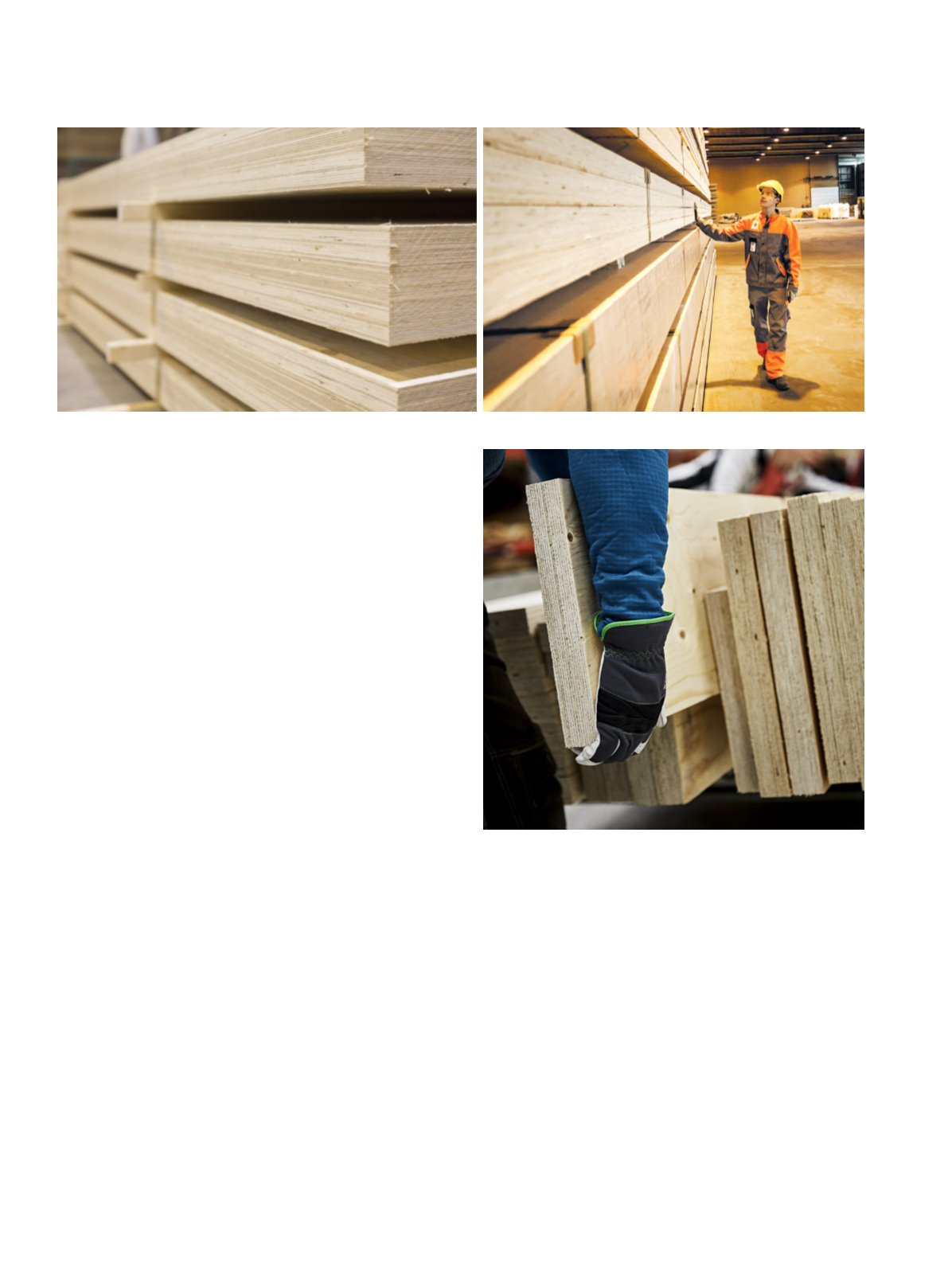
Figure 3.5.
Handling of LVL beams
Figure 3.4.
Storage of LVL packages
110
LVL Handbook Europe