



 111 / 228

3. PURCHASIG, TRANSPORT, HANDLING AND STORAGE OF LVL
3.1 PURCHASING LVL
Standard sizes of LVL-P beams and studs are readily availa-
ble from local wholesalers or distributors’ stocks, and in some
countries LVL-C panels are also stocked. Larger quantities and
special specifications are produced to order. LVL manufactur-
ers have their own sales offices or agencies in most European
countries.
The following information should be specified in a quotation
request and order specification for LVL:
• Name of customer
• Delivery address
• Requested week of delivery to customer
• Invoicing address and VAT number of customer
• Product type (LVL-P or LVL-C and the grade)
• Cross section dimensions (thickness x width)
• Length
• Number of pieces of each product type and size
• Surface: unsanded, sanded and/or calibration
• Special tolerances, if non-standard
• Product labelling: with CE-mark stamp on each product or
without stamping
• Machining drawing reference, if relevant
• Packaging:
• Package size: max. weight or package height
• Wrapping: LVL supplier will propose a suitable wrapping
type, but customer specific requirements are taken into
consideration
• Required certification (PEFC or FSC on request)
• Terms of delivery:
• Road, rail or ship
• For rail transport: if there are several delivery addresses
for the same load, a loading order is required
• Availability of special surface qualities to be verified sepa-
rately. As a default, all products have the same visual grade.
An individual production instruction is prepared for each or-
der at the mill. Any additional information needed is obtained
from the customer before production.
3.2 TRANSPORT, HANDLING AND
STORING OF LVL
LVL products – as with all engineered wood products – must
be handled and stored properly and carefully to protect them
from damage and dirt. Incorrect handling and storage may
damage or blemish the surfaces, edges or corners or reduce
the dimensional stability of the product.
Transport
Exposure to moisture, e.g. from rain or splashing, must be
avoided during transportation and storage of the product. If
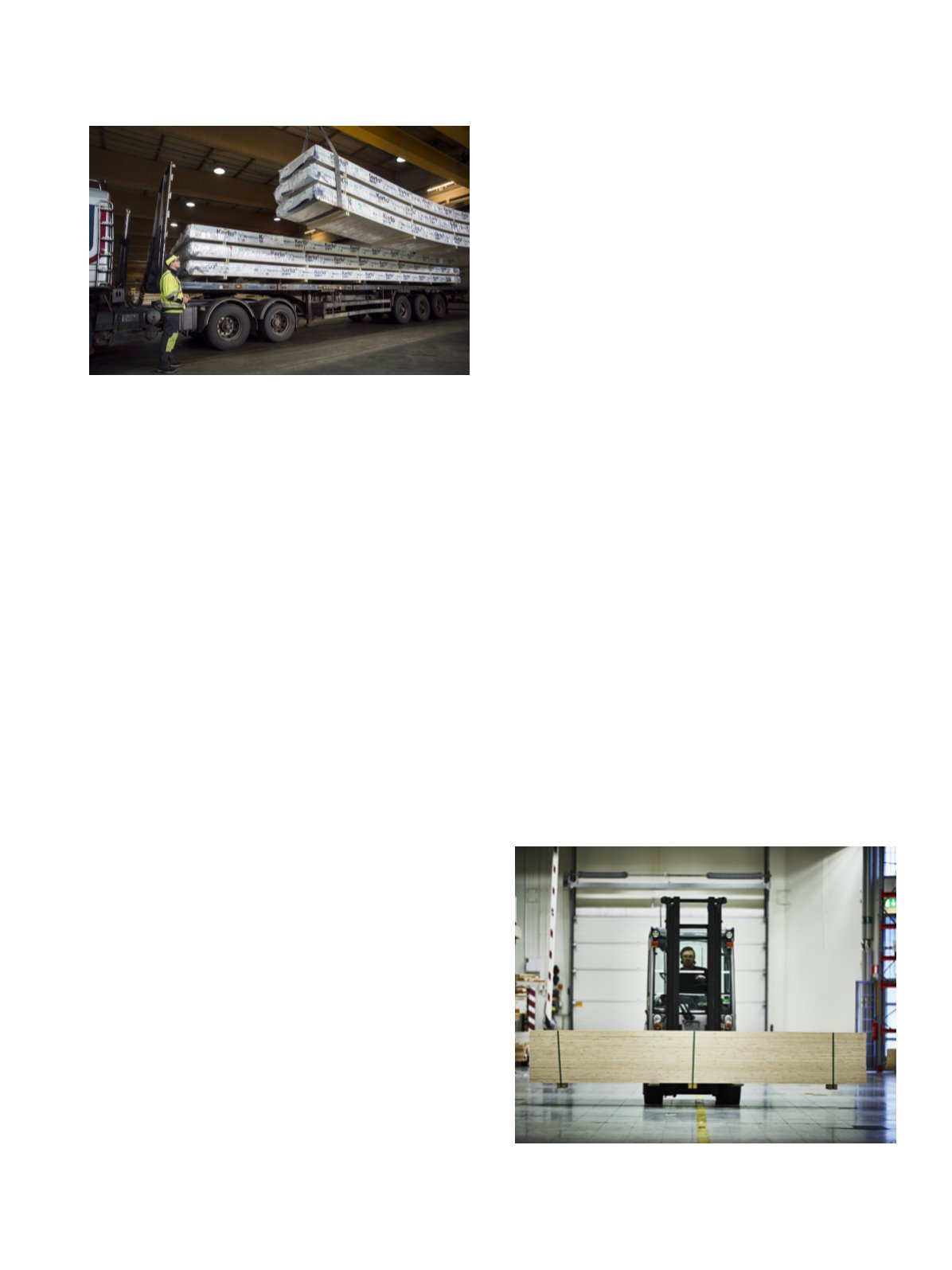
moving the product with a forklift truck, wide enough forks
must be used to avoid damage. When lifting several packs at a
time, the distance between forks must be wide enough to en-
sure safe lifting. Surface-treated products should be delivered
direct to site without additional unnecessary off-loading dur-
ing delivery
2, 27
.
Figure 3.2.
Loading LVL packages with an overhead crane for truck
transport.
Figure 3.3.
Use wide enough forks when moving LVL packages
with forklift to avoid damage.
Metsä Wood
Stora Enso
LVL Handbook Europe
109