



 60 / 228

2. LVL STRUCTURES IN FLOORS, WALLS, ROOFS AND IN SPECIAL APPLICATIONS
2.2.3 Rim boards and rim beams
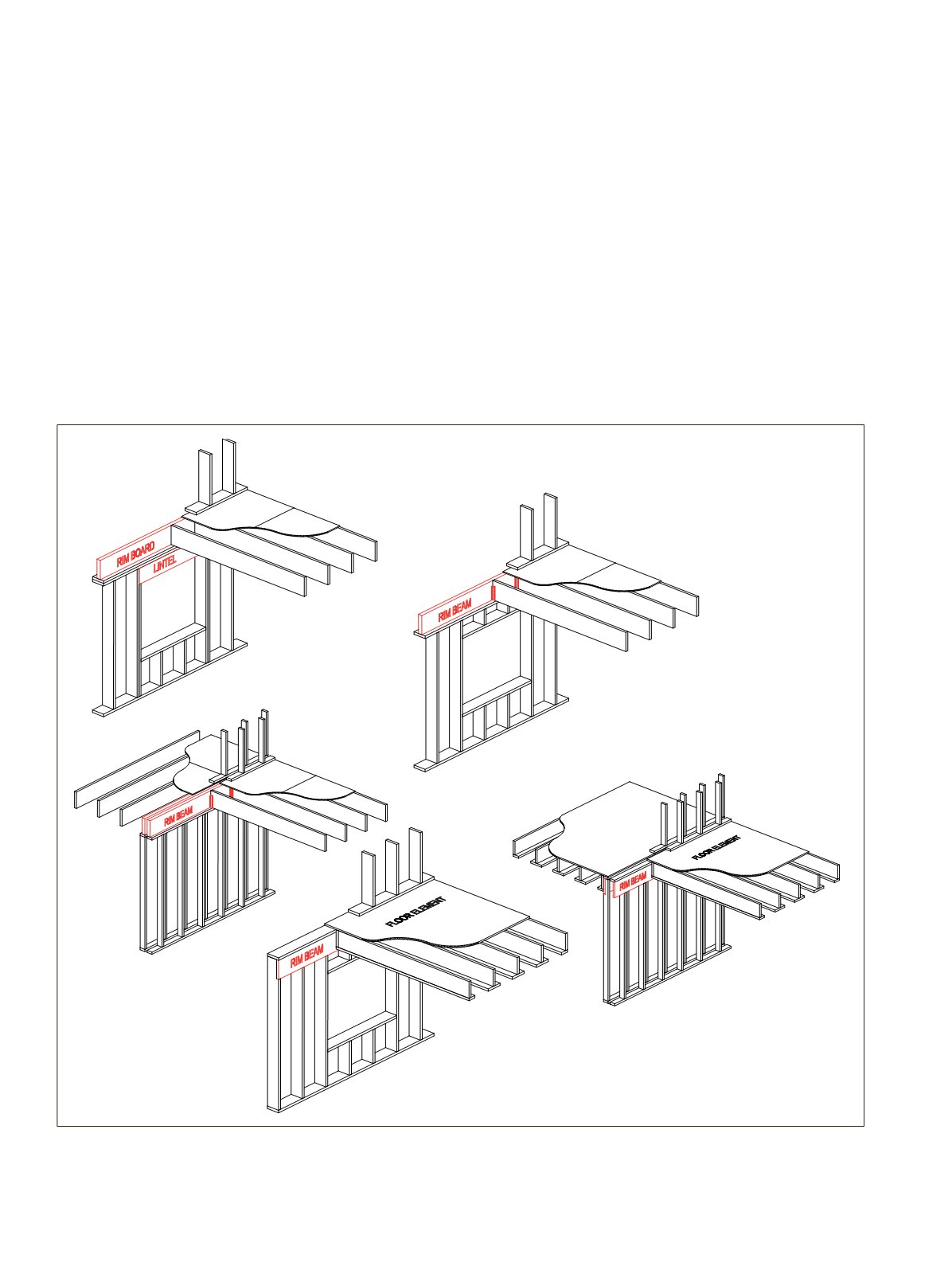
Rim boards and rim beams are used in the walls around the
timber frame floors and, depending on the structural system,
they may have several different load-bearing functions. Rim
boards work as edge binders preventing the joists from tilting,
and as load transfer members for the timber floor assemblies
by carrying the line loads from the walls above the floor level
to the supporting walls below the floor level. Continuous rim
beams are required for floor panel diaphragms to absorb the
tensile forces from the floor planes.
LVL-C products are supplied dry in long lengths and they
have good resistance, stiffness and dimensional stability in the
floor joist height direction, which makes them an ideal prod-
uct for rim boards. LVL-C settlements are minimal, which
prevents the risk of compression cracks in plasterboard walls or
facade rendering and enhances building envelope airtightness.
In partition walls between apartments rim boards must be
designed for adequate resistance to fire to prevent fire spread
in wall or floor cavities. A 30 mm rim board can serve as a fire
separating component to meet the integrity E and insulation I
performance criteria for 30 minutes for the structure.
Rim beams may also be designed in more robust dimen-
sions to act at the same time as lintels to carry loads, e.g., above
door or window openings. In such cases, bending strength and
stiffness are important. In some structural systems rim boards
work as secondary load transfer routes to prevent dispropor-
tionate collapse if, e.g., a part of the wall structure is destroyed.
A
C
E
D
B
Figure 2.12.
Rim boards and rim beams in different structural solutions of timer frame structures A) Rim board as egde binder and transferring
loads from upper walls; B) Rim beams acting at the same time as a lintel over a window opening; C) Rim beam in compartment wall connection;
D) Rim beam integrated in exterior wall element; E) Rim beam integrated to compartment wall element.
58
LVL Handbook Europe