


 53 / 228

2. LVL STRUCTURES IN FLOORS, WALLS, ROOFS AND IN SPECIAL APPLICATIONS
Eurofins
2.1 GENERAL
LVL is available in a large variety of standard stock sizes, as
well as in user-defined cross sections. Tall and slim beams and
studs are useful, for example, for reducing heat loss through
wall, floor and roof structures, while optimized cross section
improve material efficiency and high bending stiffness mini-
mizes deflection. Long LVL beams are well suited as headers
and multi-span purlins in roof constructions. LVL can be eas-
ily combined with other structures with standard connection
parts and simple joint details. LVL material values and design
methods are carefully tested to provide reliable information
for designer to specify robust load-bearing wooden structures.
LVL-P has the highest bending strength and stiffness
properties and is therefore the standard choice for beam struc-
tures. However, sometimes structural details can cause local
stresses, such as connection forces at an angle to the grain, and,
in such cases, LVL-C with its reinforcing cross-bonded veneers
is the preferred product. LVL-C has better stiffness, resistance
and dimensional stability in the cross direction and is therefore
recommended for members mainly loaded in the cross direc-
tion, such as rim boards.
2.2 FLOOR STRUCTURES
LVL offers numerous alternatives for creating floor structures,
from traditional joist floors to stressed-skin panels andmassive
floor panels. LVL-P joists have precise dimensions and good
modulus of elasticity, which are important for a robust and
convenient floor. Stressed-skin panels can achieve the longest
spans, andmassive LVL panels minimize the height of the floor
structure. Straight, precise and dry LVL-P joists are ideally suit-
ed for off-site production of floor elements.
2.2.1 Beam& joist floors
In wooden joist floors the serviceability design of deflections
and human-induced vibration from walking are usually the
most important design tasks. Wooden joists are strong, so
the strength design is rarely an issue if the supports are wide
enough. LVL joists are ideal for timber frame floors as they are
rigid and straight with accurate dimensions. They are supplied
at a moisture content close to that of the ready building, which
reduces deformation and creaking.
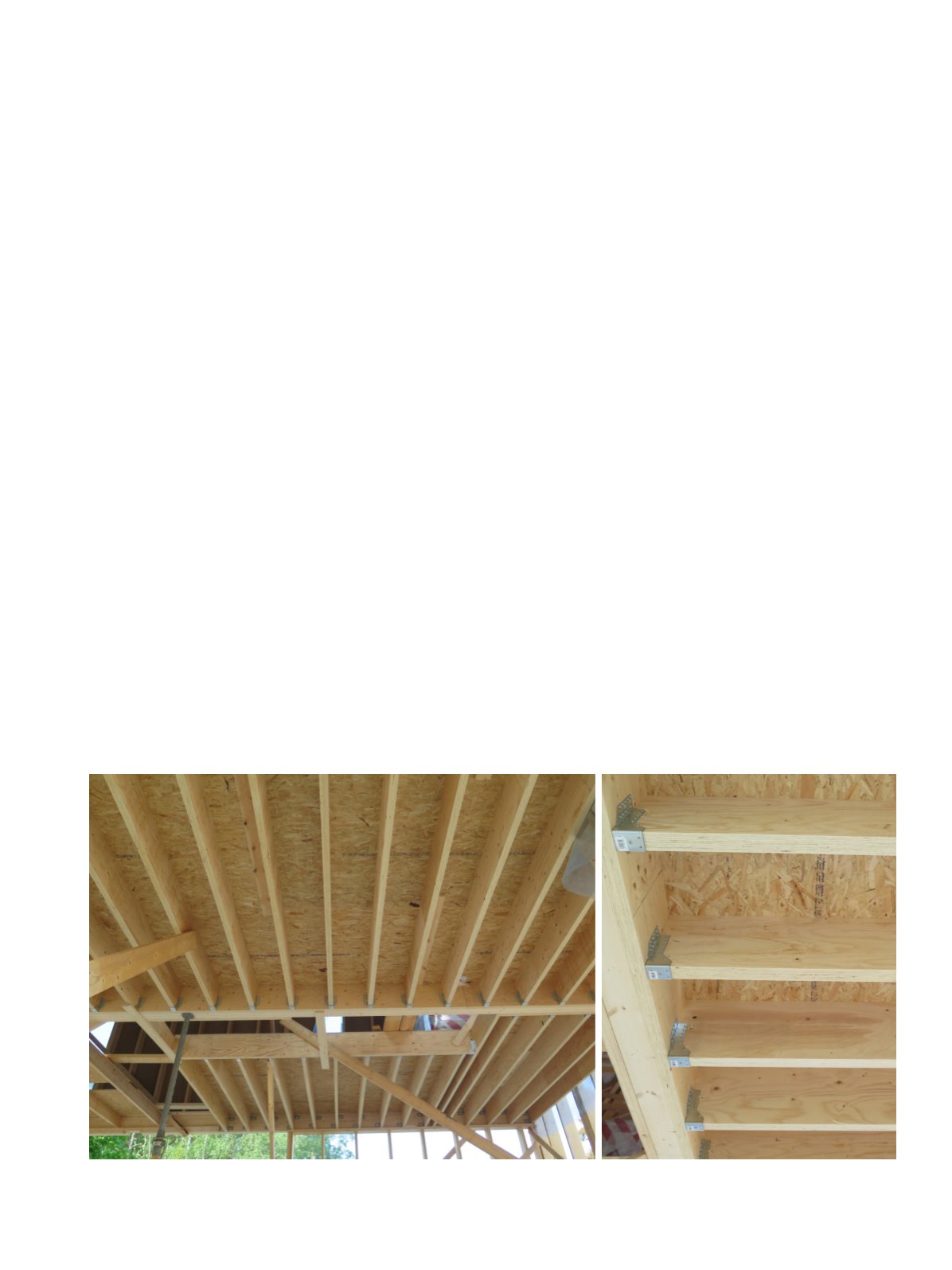
Figure 2.2.
LVL-P joist floor structures.
Figure 2.3.
Joist hanger connections of floor joists.
LVL Handbook Europe
51