


 49 / 228

1. LVL AS A CONSTRUCTIONMATERIAL
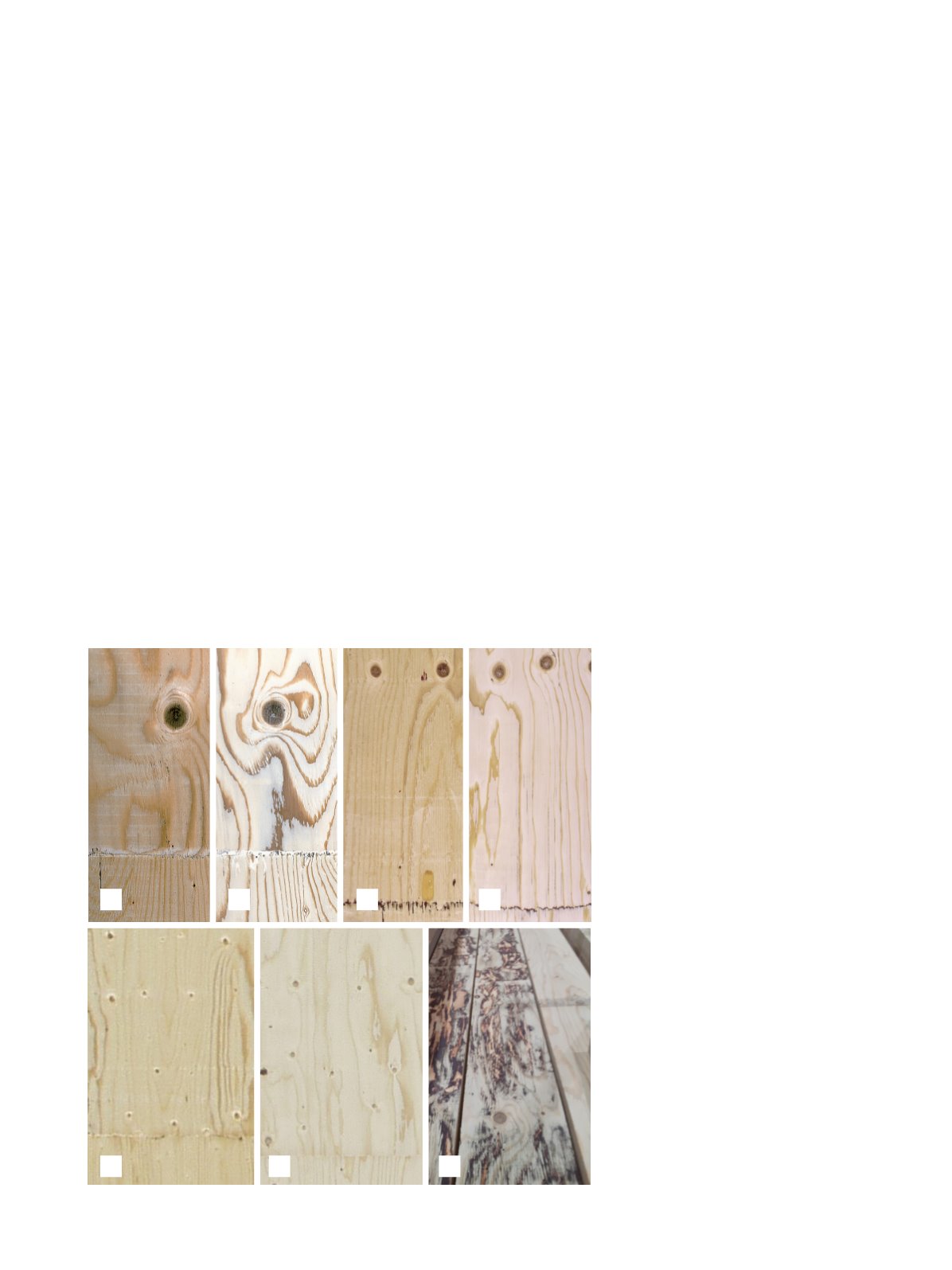
Figure 1.65:
Appearance of LVL veneer surfaces
1. Unsanded front side, close image 2. Optical
sanded front side, close image 3. Unsanded
reverse side with dark scarf-joint glue line, close
image 4. Optical sanded reverse side with dark
scarf-joint glue line, close image 5. Unsanded
front side, general view 6. Optical sanded
front side, general view 7. Calibration sanding
revealing the dark glue line
11
.
1
5
2
6
3
6
4
Metsä Wood
resist seismic loads. LVL-Cmembers, in particular, are not sen-
sitive to cracking or brittle failures of connections, so they can
yield and absorb more energy. Full utilization of these proper-
ties and use of LVL in higher dissipative classes for structures
in seismic design requires testing in cyclic loading according
to EN 12512 for combinations of LVL panels and dowel type
connections.
1.12.7 Visual properties of LVL surface
Softwood LVL is produced from peeled conifer softwood
veneers. An inherent characteristic of conifer wood is that
branches are located in star-like clusters along the stem (knot
ringlets) and therefore there may be frequent knots in a peeled
veneer.
LVL is mainly used as a structural load-bearing product
for non-visible applications. Therefore, the sorting of veneers
in production is based mainly on the strength properties of the
veneers, not on their visual properties. During peeling, small
peeling cracks are formed in the veneer. These cracks may be-
come visible due to swelling or shrinkage caused by moisture
variations or sanding. In addition, the scarf-joints of face ve-
neers can sometimes overlap, leaving the joint slightly open.
Due to moisture variations this may also occur later on the sur-
face of sanded products. Other possible surface defects include
resin pockets, bark, and splits. Unsanded surfaces may have
some stains of adhesive from the production process. Some
manufacturers provide higher grade face veneers on special
request.
On the front side of the product a light-coloured mela-
mine adhesive is used for scarf-jointing the surface veneers.
On the reverse side the scarf-joints are glued with the same
dark brown phenol resin adhesive used in the glue lines be-
tween veneers. The distance between scarf-joints is usually 1.9
m or 2.5 m depending on the production process. When LVL
members are used in visible applications, the designer specifies
which side of the member is the visible surface. This must also
be taken into consideration especially when the LVL is to be
cut into special shapes.
Standard LVL is delivered unsanded. It can, however, be
sanded to improve the visual appearance of the LVL surface by
so-called optical sanding which cleans and smoothens the sur-
face by removing any dark glue stains and equalizing any local
colour differences of the veneers. Another alternative sanding
treatment is calibration sanding, which can be carried out to
achieve more precise thickness tolerances for, e.g., LVL door
components. Unless some non-transparent coating is used on
the surfaces, the calibrated sanding is not recommended for
visible applications, because it can sand through the surface
veneers revealing the dark glue line especially in the thicker
range of the products 11. For more information on sanding
specifications, see subsection 1.7.1.
LVL Handbook Europe
47