


 46 / 228

1. LVL AS A CONSTRUCTIONMATERIAL
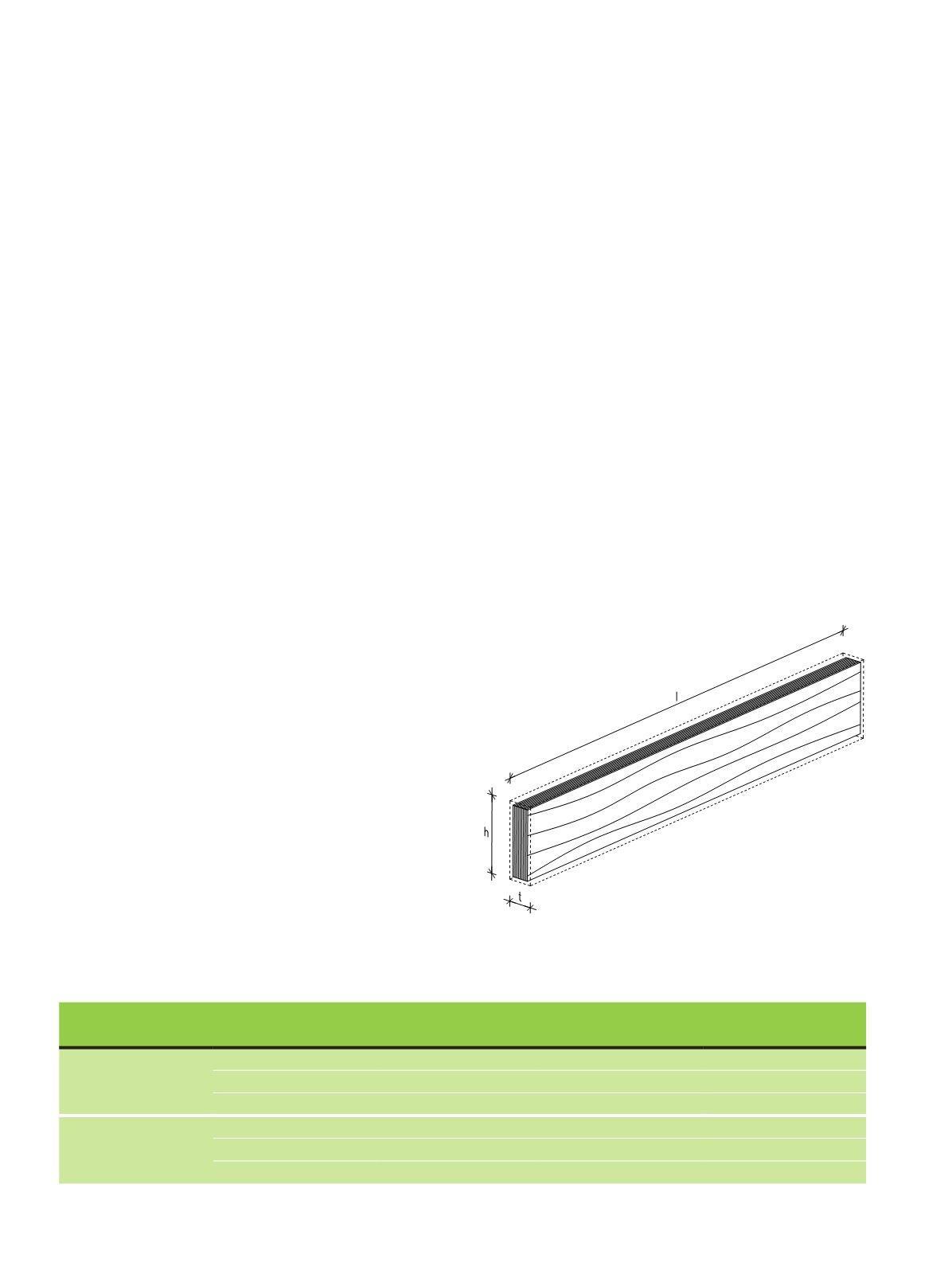
Table 1.10.
Example dimensional changes due to a 3% increase in moisture content (MC) %.
Figure 1.64.
Dimensional changes due to increased moisture
content.
LVL 01, Table 1.11
Product type
Direction
Original dimension Dimension after +3%
increase in MC
Difference
LVL-P
Length
l
[mm]
5000
5001,5
+1,5 mm
Thickness
t
[mm]
57
57,5
+0,5 mm
Height
h
[mm]
260
262,6
+2,6 mm
LVL-C
Length
l
[mm]
5000
5001,5
+1,5 mm
Thickness
t
[mm]
57
57,5
+0,5 mm
Height
h
[mm]
260
260,3
+0,3 mm
1.12 BASIC PROPERTIES OF LVL
1.12.1 Strength and stiffness properties
LVL has homogeneous material properties, firstly, due to the
breakdown and uniform distribution of natural defects, such
as knots, in the product and, secondly, due to the effect of lami-
nation, which further eliminates their impact. Strength grading
of the veneers also reduces variation within each strength class
of the product. This results in strength levels that are close to
defect-free wood for the highest LVL grades and, due to low
variation, the characteristic 5% fractal values used in structural
design are also high.
LVL-P has the highest strength and stiffness properties
parallel to grain. LVL-C has about 20% lower values parallel to
grain due to its cross-bonded veneers, but is stronger and stiff-
er perpendicular to the grain direction of the surface veneer,
properties which can be utilized in panel structures. Table 1.11
presents the basic mechanical properties of the typical strength
classes of LVL.
The variation in bending strength and stiffness properties
for LVL is typically less than 10% compared to 12-20% for glu-
lam and plywood and 15-30% for structural timber. Therefore,
the characteristic 5% fractile values of non-LVL materials for
structural design are significantly lower
16
. Table 1.12 compares
the basic mechanical properties of some common structural
wood products.
For more information on the mechanical properties of
LVL, see Section 4.2.
1.12.2 Building physics properties
Moisture
LVL products are delivered from the factory at a moisture
content (MC) of 8-10%, which is close to the MC of service
class 1 end uses. This significantly reduces initial dimensional
changes due to moisture in structures if the members are
protected against weather exposure. LVL swells when its
moisture content increases and shrinks when its moisture
content decreases
18
.
The extent of these dimensional changes depends on the
grain direction and the product type. Table 1.10. shows an ex-
ample dimensional change for a 3% increase in moisture con-
tent. LVL-C undergoes a much smaller change in beam height
because the cross veneers efficiently prevent movement in the
height direction.
Untreated wood surfaces are hygroscopic, meaning that
they absorb moisture from humid air and release moisture to
the surrounding air when the RH is low. This moisture buffer-
ing phenomenon may be useful for improving the indoor air
quality of buildings.
Thermal properties
LVL has a thermal conductivity λ of about 0,13W/mK depend-
ing on its density and moisture content, and a specific heat ca-
pacity cp of 1600 J/(kg K) according to EN ISO 10456.
Thermal expansion of LVL is negligible and its dimensions
remain stable during temperature changes. Therefore, temper-
ature variation does not need to be considered in structural
design, unlike swelling and shrinkage due to moisture changes.
For further information on building physics, see Chap-
ter 8.
44
LVL Handbook Europe