


 84 / 228

2. LVL STRUCTURES IN FLOORS, WALLS, ROOFS AND IN SPECIAL APPLICATIONS
2.3.6 Bracing panels
Bracing is needed to transfer horizontal loads, like wind loads,
from the building frame to the foundations. When panel brac-
ing is used, additional diagonals or other bracing systems
are usually not necessary and the structure becomes simpler.
LVL-C panels are ideal for bracing in various types of buildings
as they are easy to fasten to most materials and LVL-C panels
are available in large sizes. Frame spacing can be large without
risk of bracing panel buckling. Horizontal bracing panels trans-
fer horizontal loads to the vertical wall bracing panels which, in
turn, transfer the forces downwards. If the edges of the panels
are not fully supported, the resistance against lateral torsional
buckling of the compressed edge must be verified as a beam.
Fastening the panels to the frame structures is essential for the
capacity of the bracing. Preliminary design values for panel
fastenings are presented in Section 5.7.
In roofs and walls of conventional buildings, LVL-C pan-
els can also be utilized as a water vapour and air barrier on
the interior side of the structure, so no separate barrier layer
is needed. The fire behaviour of LVL-C is highly predictable,
which makes it a suitable bracing panel also with respect to
fire design
24
.
2.3.7 Large LVL I-beams and box beams
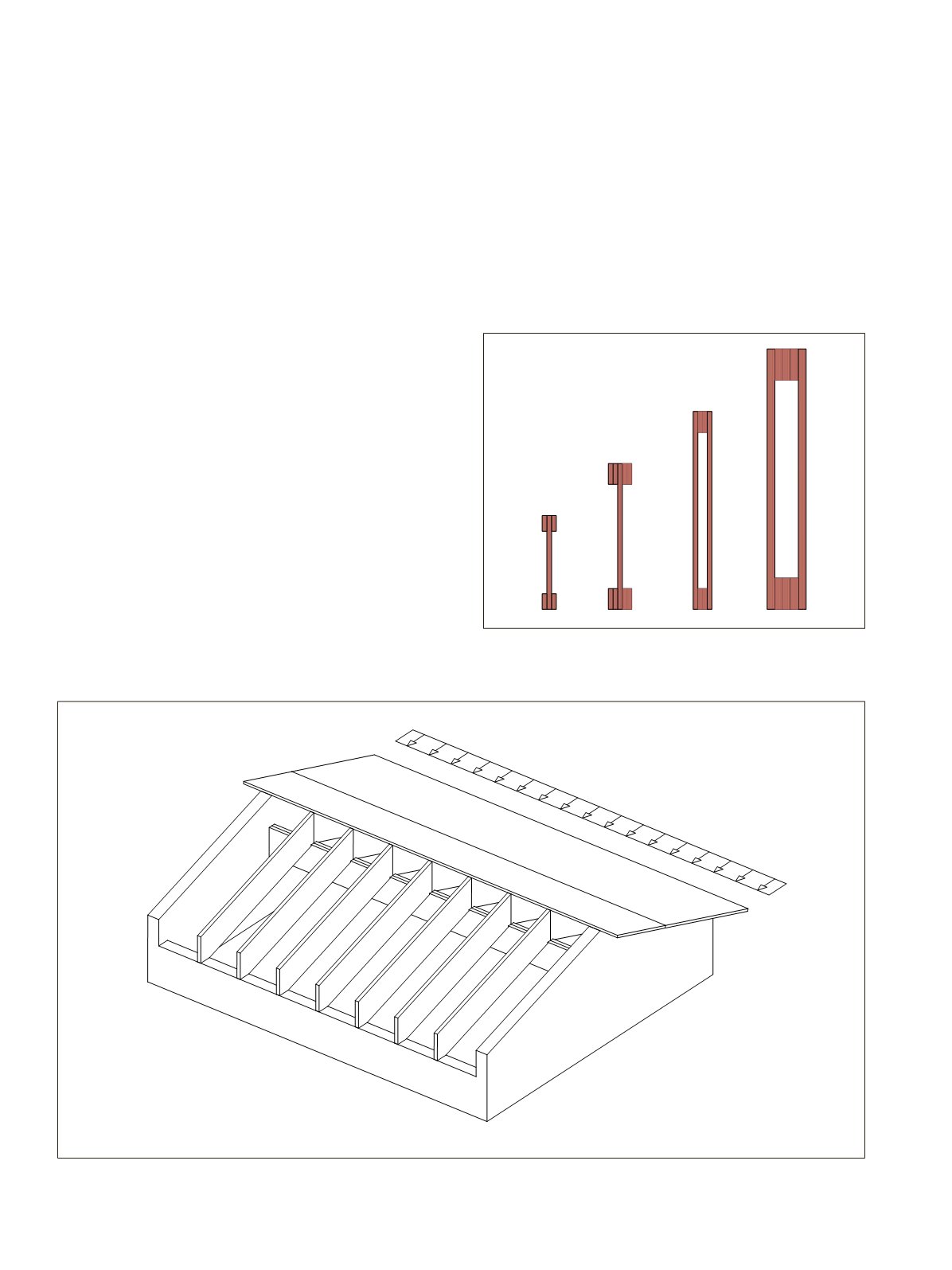
LVL can be used for the main beams of roof structures in large
buildings when they are structurally glued to larger I-beams or
box beams. The advantage of these LVL beams is that they are
not sensitive to cracking in dry or changing moisture condi-
tions. The beamheights can also be tailored project-specifically.
The beams have LVL-C webs and LVL-P flange components.
Recommended beam heights are 900, 1200, 1800 or 2500 mm.
I-joists have the best material efficiency, but if the fire resist-
ance requirement is higher than R15, box beams are required.
Figure 2.52.
Panel bracing of roof structure.
Figure 2.53.
Large LVL I-beams and box beams for main beams of
roofs.
82
LVL Handbook Europe