



 33 / 228

1. LVL AS A CONSTRUCTIONMATERIAL
1.6.4 Layup and hot pressing
Glue is mixed on site from resin, hardener and water. In the
manufacture of LVL, phenol formaldehyde resins are mainly
used at approximately 30 kg dry weight per cubic metre of LVL.
Veneer of the required length and proper bonding are
achieved by scarfing a bevel at both ends of the veneer. The
scarfed veneers are fed to the layup line, glued on one side, and
then laid in a staggered configuration (see Fig. 1.40) to form a
continuous billet of LVL. The veneers are normally fed parallel
to the grain direction, although some veneers are laid cross-
wise in certain products. LVL is typically assembled from an
odd number of plies. Special structures can also be produced
to meet specific end use requirements.
Layup starts at the layup table where the veneers are
laid with a staggered edge spacing of approximately 120 mm
(see Fig.19). The resulting staggered jointing maximizes the
strength properties of the LVL.
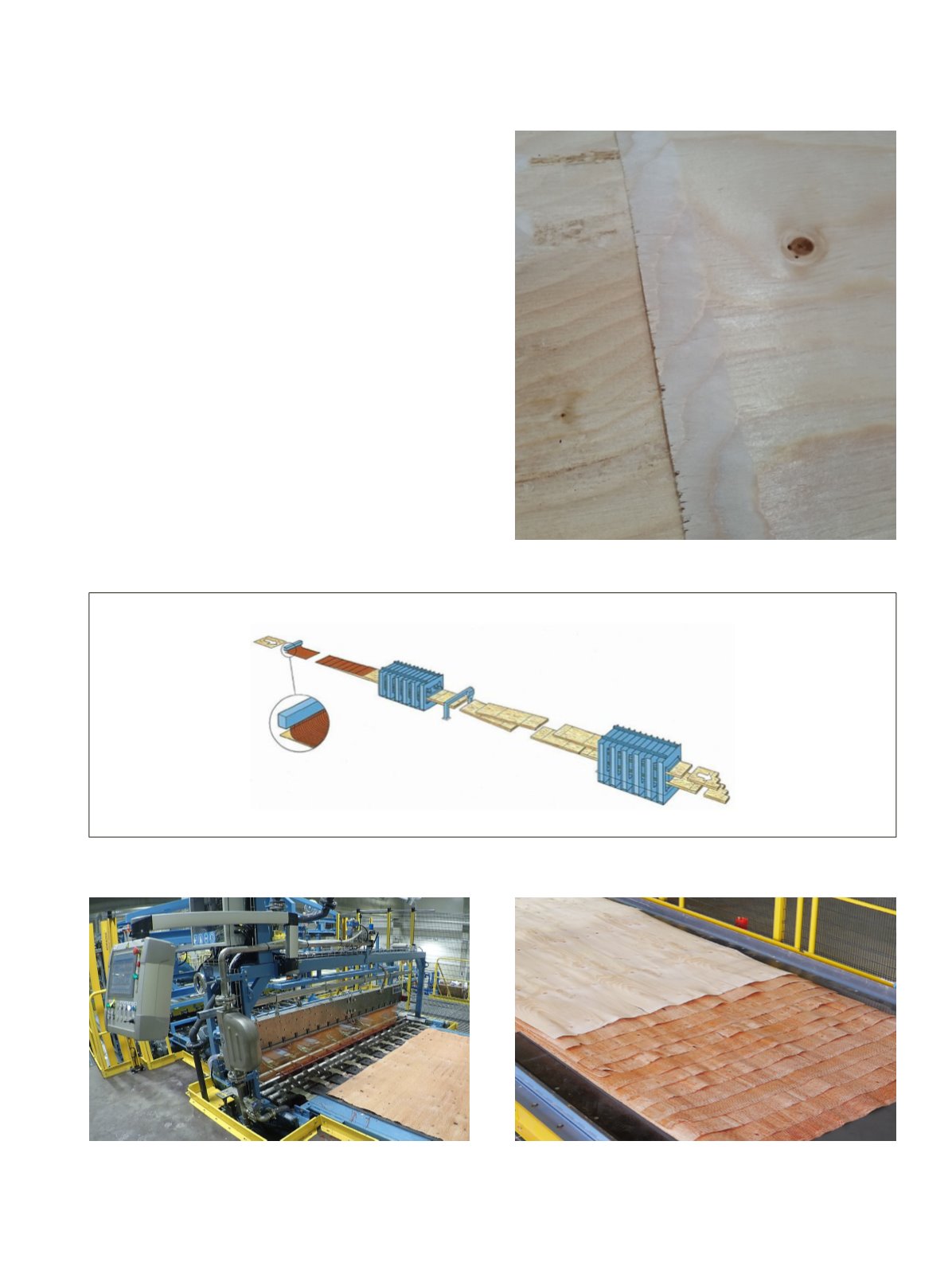
Figure1.37.
Scarfed veneer end.
Figure 1.38
Layup line principle.
Figure1.39.
Liquid extruder gluing (LEG): glue is applied to the top
of the veneer as it passes on the belt conveyor.
Figure1.40.
Staggered layup ahead of the pre-press.
LVL Handbook Europe
31