


 36 / 228

1. LVL AS A CONSTRUCTIONMATERIAL
1.7 FURTHER PROCESSING
LVL manufacturers offer further processing of their products
according to customer specifications as value-added services.
This is done either directly at the mill or by subcontractors
equipped with special machinery for LVL processing. The val-
ue-added services save time and minimize waste for the cus-
tomer and on the building site.
1.7.1 Sanded surfaces: optical or
calibration sanding
Standard LVL is delivered unsanded. It can, however, be sand-
ed with two alternative specifications. The visual appearance
of LVL can be improved by optical sanding, which cleans and
smoothens the surface by removing dark glue stains and equal-
izing local colour differences of the veneers. Optical sanding
can be carried out on one or both sides and reduces the thick-
ness of the product by approximately 2 mm (1 mm per sur-
face). In visible applications it must be noted that on the front
face of the LVL member the scarf-joints of the surface veneers
are glued with colourless glue, but on the bottom side the scarf-
joint glue line is dark brown, similar to the glue lines between
veneers
11
.
Another sanding treatment that can be performed is cali-
bration sanding for thickness calibration, which is carried out
on both sides of the LVL. Calibration sanding reduces the
thickness of the product by approximately 3 mm (1.5 mm per
surface) and the thickness tolerance after calibration is ± 0.5
mm. Unless a non-transparent coating is used on the surfaces,
calibration sanding is not recommended for visible applica-
tions because it can sand through the surface veneers revealing
the dark glue line, especially in thicker products.
The nominal sanded dimensions of the product must be
used in structural design calculations.
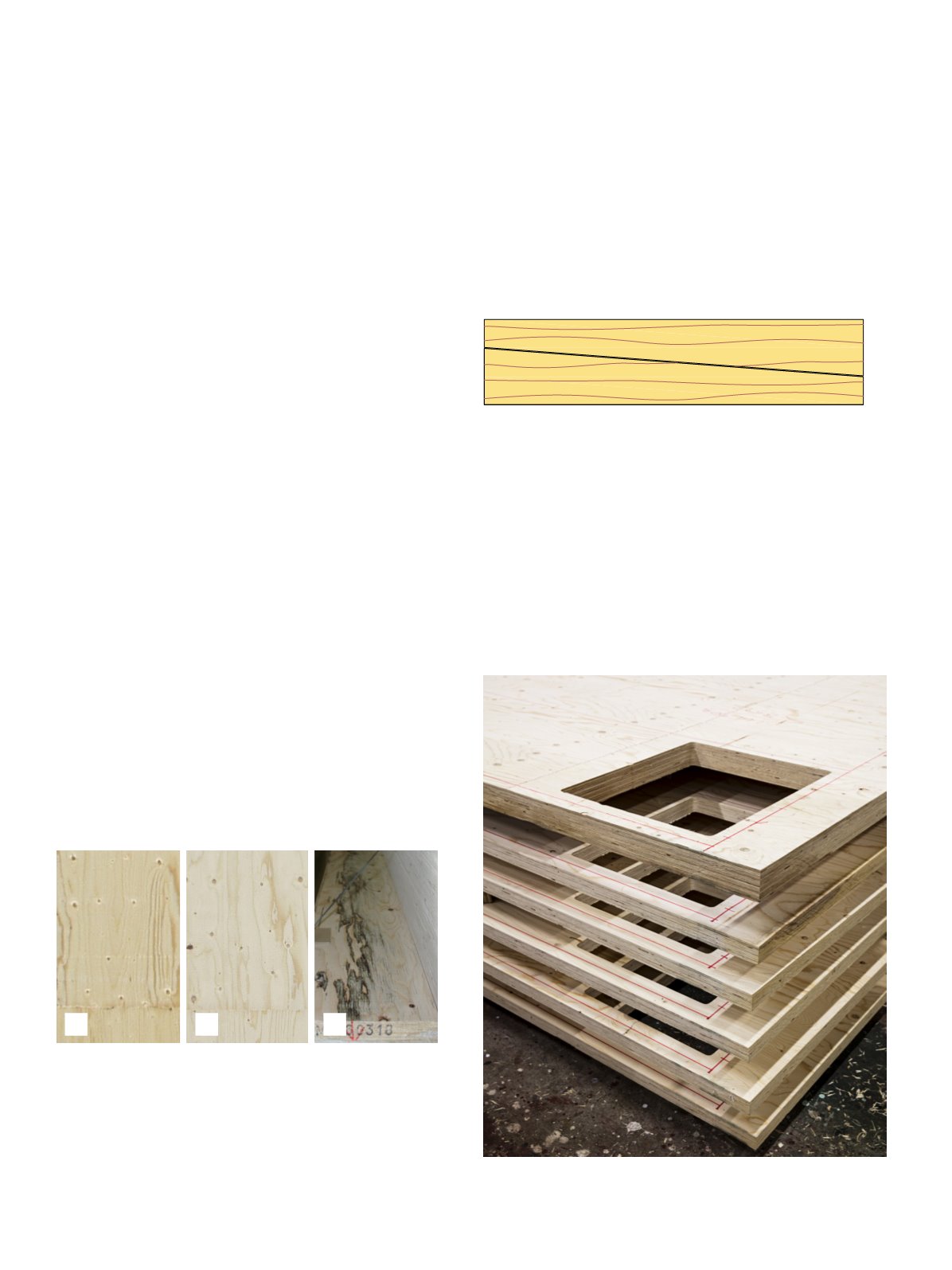
Figure 1.47.
Principle of diagonal sawing of LVL panel to produce
single-tapered column and rafter members of portal frames.
1.7.3 CNC Machining
CNCmachining enables drillings, holes, notches and end slop-
ing of beams. The machining requires a geometry file of the
members from the customer, e.g. a DWG drawing at 1:1 scale
drawn with closed lines for each different type of member to
be machined.
Figure 1.48.
Holes in LVL panels.
1.7.2 Special cutting
LVL panels or beams can be sawn to special shapes or sawn di-
agonally to produce tapered beams or columns. Manufacturers
may also have special cutting tolerances for tailored products,
e.g. of industrial customers.
Metsä Wood
1
2
3
Figure 1.46.
Appearance of LVL veneer surface 1. Unsanded face
side. 2. Optical sanded face side. 3. Calibration sanding revealing
the dark glue line.
34
LVL Handbook Europe