


 14 / 228

1. LVL AS A CONSTRUCTIONMATERIAL
1.2 WHERE CAN YOU USE LVL
Figures 1.6-1.10 present a number of applications for LVL in
low-rise buildings, multi-storey buildings, hall constructions,
and some special applications.
Other common applications of LVL include scaffold
planks for construction sites, concrete form work support
beams, door panels, door and window frame components, and
wooden I-joist flanges.
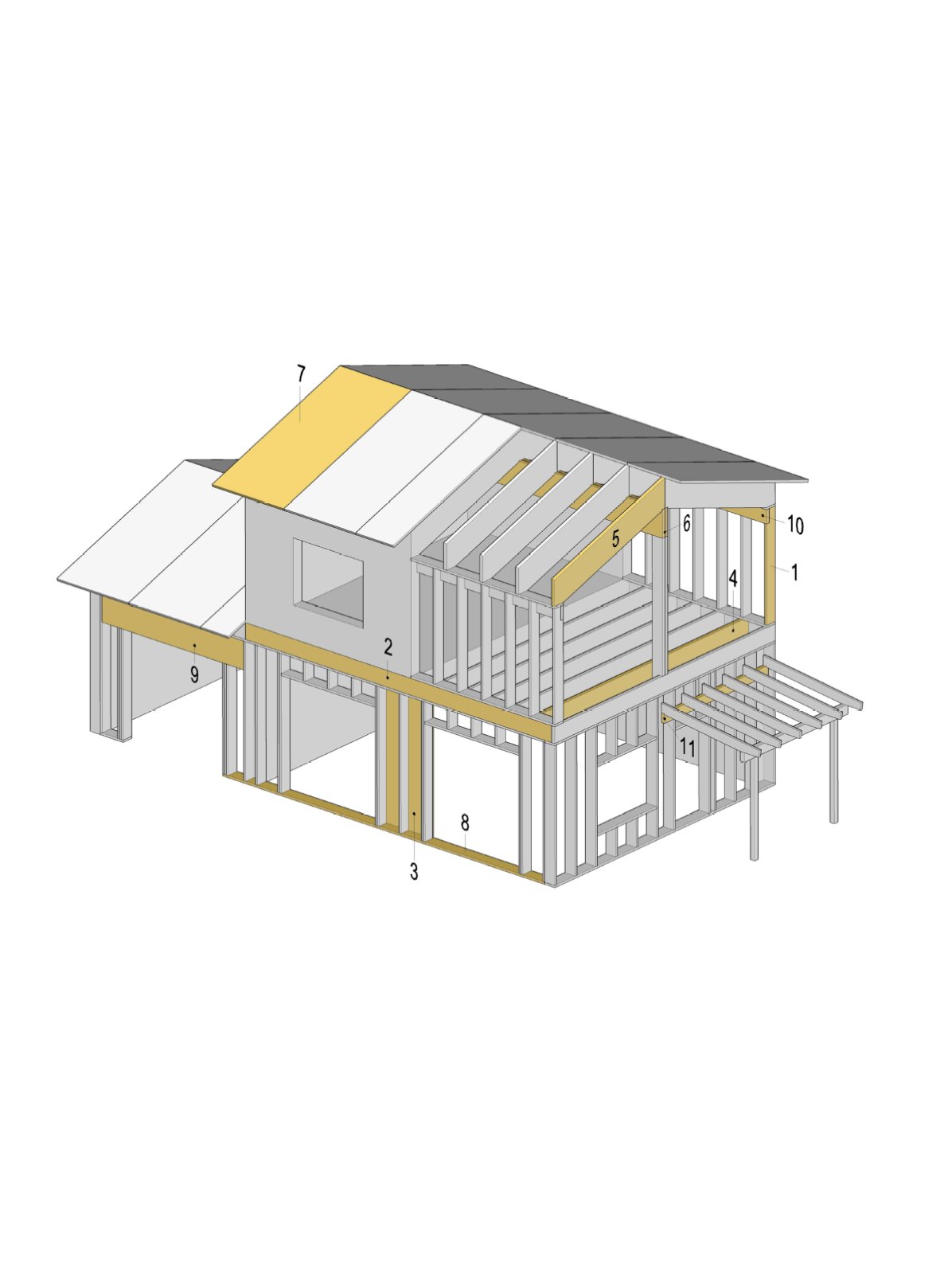
1. LVL-P load-bearing wall stud: straight and
precise dimensions.
2. LVL-C rim board: dimensionally stable,
minimal settling.
3. LVL-C bracing panel: narrow, but robust
panel next to large openings in walls
when there is no space for large panel
fields.
4. LVL-P floor joist: strong and rigid.
5. LVL-P roof rafter (or LVL-C when height-
thickness ratio is high): space for thermal
insulation of low-energy buildings.
6. Double LVL-P ridge beam: strong and
rigid.
7. LVL-C roof panel: fast installation, fewer
joints, roof overhangs without additional
supports.
8. LVL-P/C sole plate: fits stud dimensions,
thin members reduce settling.
9. LVL-P lintel over garage door opening:
large openings possible.
10.LVL-P lintel in wall to carry roof loads:
straight and rigid.
11.LVL-P ledger beam for canopy: straight
and rigid, easy details.
Figure 1.6
Applications of LVL in a timber frame house.
12
LVL Handbook Europe