


 11 / 228

1. LVL AS A CONSTRUCTIONMATERIAL
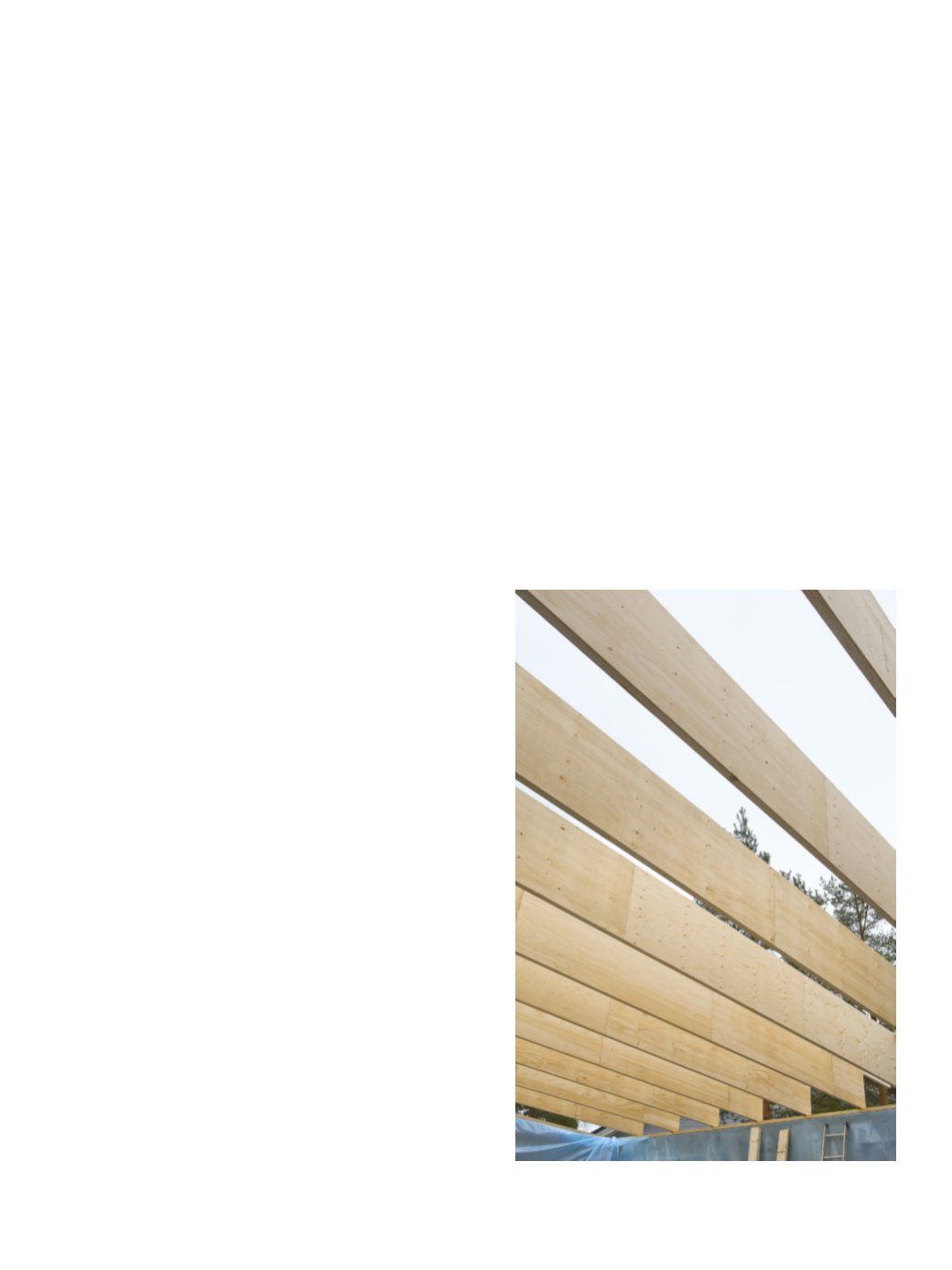
Figure 1.2
LVL roof rafters.
1.1 INTRODUCTION
Laminated veneer lumber (LVL) is an engineeredwood product
used in a diverse range of building and bridge construction
applications. LVL beams, columns and panels have become
established as essential components in modern timber
construction due to their numerous advantages, versatility
and proven structural performance. This handbook describes
the state of the art of LVL from properties and applications to
production and design methods.
LVL is made of 3 mm thick veneers bonded together with
weather-resistant phenolic adhesive. This means that the di-
mensions of the final LVL product are not limited by the di-
mensions of the rawmaterial, and even small-diameter logs can
be used to produce large LVL beams and panels. When veneer
logs are peeled to produce veneer, any natural defects in the
wood, such as knots, are dispersed as small fragments across
the veneer. This, together with the lamination effect, eliminates
the impact of defects and results in exceptionally homogeneous
material properties. Although the production costs of LVL, like
all engineered wood products, are higher compared to sawn
timber, with LVL the same constructions can be designed with
smaller dimensions and LVL can also be used for applications
where suitable sawn timber sizes are not available.
The low deviation of LVL’s high strength and stiffness
means that these properties can be fully utilized as character-
istic values in structural design. In addition, due to the lack of
sizeable defects, the strength to weight ratio of LVL is extremely
high – LVL is twice as strong as steel in proportion to weight.
Due to its laminated structure, LVL is also dimensionally sta-
ble and free of warps, splinters and splits. LVL also comes dry
from the factory, eliminating the risk of shrinkage on site or in
the ready building, as long as the LVL members are protected
against weather exposure.
LVL is manufactured to exact dimensions, minimizing
cross cutting and sawing waste. The resulting low material
waste and uniform quality of LVL improve overall material
and time efficiency, especially in industrial applications and
off-site production of construction elements. LVL is easy to
drill, cut, fasten and fit – only standard wood working tools are
needed. LVL components are also highly portable due to their
light weight. LVL can also be easily combined with other wood
products and construction materials.
LVL is produced entirely from traceable, renewable, recy-
clable wood. It is a natural material from certified sources. LVL
also serves as a carbon store in buildings: 1 m
3
of LVL contains
stored carbon equivalent to 789 kg of CO
2
, making it an envi-
ronmentally friendly choice
1, 2, 3
.
Features and Benefits
• Twice as strong as steel in proportion to weight.
• Dimensionally stable, no twists, splinters or splits due to
laminated structure.
• Homogeneous material properties.
• Uniform quality and dimensions of the end product; key ad-
vantage in industrial applications.
• Easy to drill, cut, fasten and fit, only standard wood working
tools needed.
• Precision-engineered and easily tailored.
• Can be produced to exact dimensions, minimizing cross cut-
ting and sawing waste.
• Wide range of sizes: product dimensions not limited by raw
material size.
• Light and highly portable.
• Dry from factory, moisture content 8-10% ensured minimal
shrinkage in situ.
• Easily combined with other construction products.
• Off-site production reduces construction time.
• Entirely traceable, renewable, recyclable wood from certi-
fied sources.
• Environmentally friendly carbon store: 1 m
3
LVL contains
stored carbon equivalent to 789 kg CO
2
.
• Production cost is higher than sawn timber, but less mate-
rial is needed to meet design specifications when building
with LVL
1, 2
.
LVL Handbook Europe
9