


 13 / 228

1. LVL AS A CONSTRUCTIONMATERIAL
1.1.2 LVL-C with cross-bonded veneers
for robust structural panels
LVL-C panel is a cross-bonded panel product with approxi-
mately 20% of the veneers glued in a crosswise direction. This
enhances the transverse strength and stiffness and the con-
nection ductility of the panel. It is dimensionally stable, as the
cross veneers prevent shrinkage and swelling in the event of
moisture changes in the panel width direction. LVL-C panels
or beams can be used as both horizontal and vertical bearers
in numerous construction applications. It is designed for use as
a large-dimension load-bearing panel, as well as for structural
bracing and stabilizing. LVL-C panel is an ideal component for
floor, wall and roof elements, roof and wall panels, and pre-fab-
ricated houses. The panels can be cut to tailored sizes and spe-
cial shapes for modern timber structures
1, 2
.
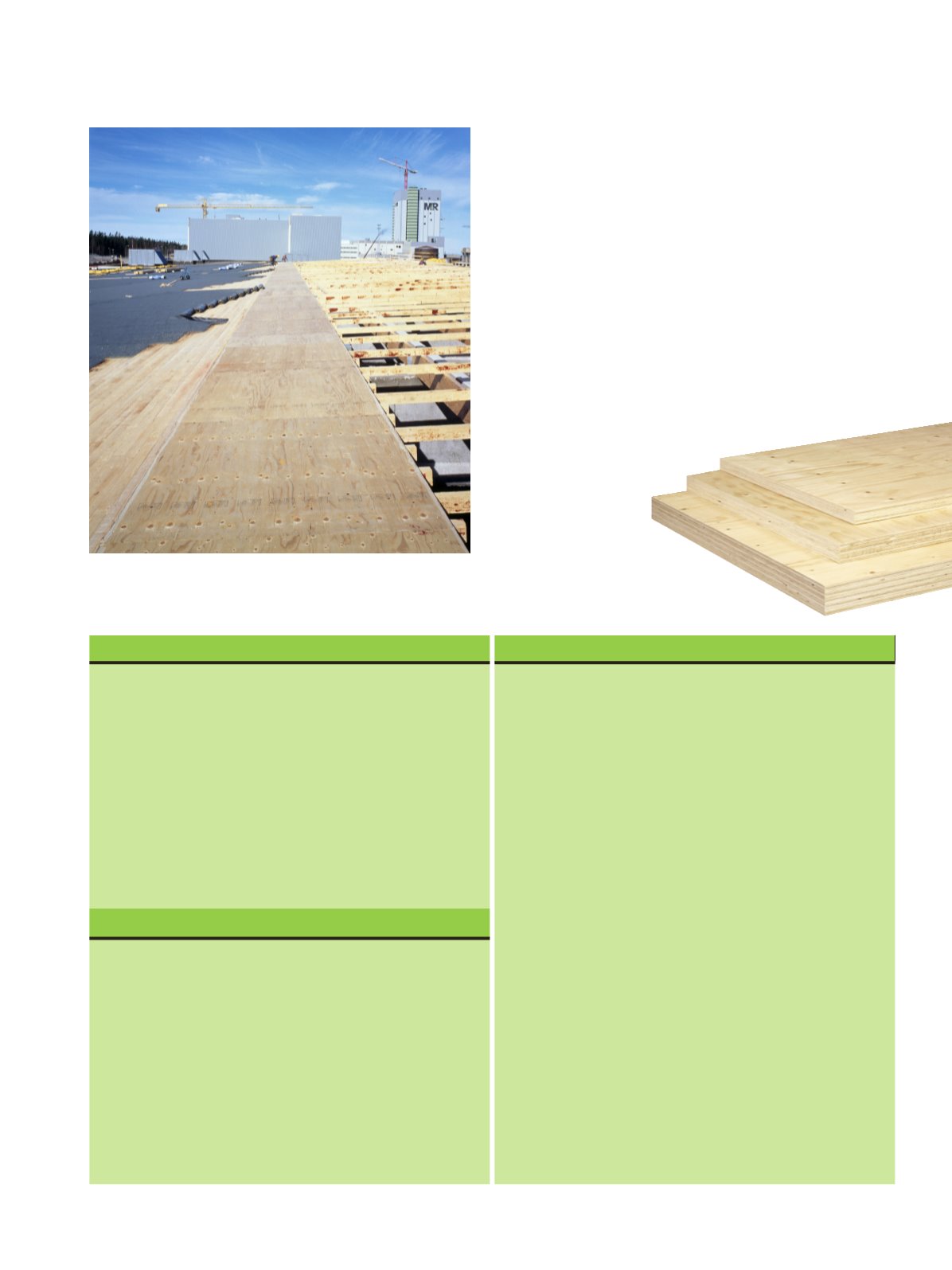
Figure 1.5
LVL-C panels.
Figure 1.4
LVL-C roof panels.
Table 1.2.
Applications for LVL-C.
Metsä Wood
LVL 01, Table 1.2
Panel applications
Features and benefits
• Large panel product for roof, floor and wall constructions
• Roof overhangs
• Pre-fabricated roof, floor and wall elements and modules
• Stresses-skin panel elements
• Door panels
• Strong and rigid: long spans with minimal deflection
• Large dimensions: applications in a wide variety of building
types
• Installation efficiency: large panel for floors, roofs and walls
covers vast areas much faster than normal size wood-based
panels reducing the amount of lifting required on the
construction site.
• High and thin beams: energy efficient constructions
• Straight and dimensionally stable; does not warp or twist:
improves construction quality
• Dry from factory: minimal shrinkage in constructions
• Customized product dimensions and shapes with minimum
waste: applications in a wide variety of building types; savings
in material costs and time on construction site
• Excellent strength-to-weight ratio: light structures
• Great workability: easy to install, staple, nail, drill and cut
without special tools
• Ductility of connections: improved safety
• Strong and rigid in edgewise compression perpendicular
to grain direction: better building quality with minimal
deformation, suitable for narrow supports
• Not sensitive to cracking under tension perpendicular to grain
stressed structures: safe connections
• Bracing of different size buildings, regardless of frame
material: applications in a wide variety of building types; large
window openings possible.
Other applications
• Rim boards
• High rafter beams
• High lintels and header beams
• Frames and truss members
• Reinforcement of old structures
• Curved components, free-form beams and panels
(CNC machining)
• Concrete formwork
LVL Handbook Europe
11