



 124 / 228

4. STRUCTURAL DESIGN OF LVL STRUCTURES
The shear strength of LVL is highly dependent on the di-
rection of the shear stress. In the edgewise orientation the shear
strength
f
v,0,edge,k
is the highest. LVL-P and LVL-C strength val-
ues are quite similar at 3,2-4,5 N/mm
2
, but in practice LVL-C
behaves more ductile (i.e. less brittle) under loading due to
the cross veneer. In the flatwise orientation the shear strength
f
v,flat,k
is smaller. For LVL-P the strength
f
v,0,flat,k
is 2-3,2 N/mm
2
,
but for LVL-C it is 1,1-1,3 N/mm
2
due to the cross veneers
which are in the rolling shear direction compared to the main
direction of the panel. In the across direction of the panel the
strength
f
v,90,flat,k
is 0,6 N/mm
2
.
Note: Multiple-glued GLVL products have manufacturer-specific
rules for size effect in flatwise shear (reference size and size effect
parameter s
flat,v
).
4.3.3 Tension parallel to the grain
The following expression shall be satisfied:
σ_(t,0,d)=F_(t,0,d)/A≤f_(t,0,d)
(4.9)
where
σ
t,0,d
is the design tensile stress along the grain;
F
t,0,d
is the design compressive force;
A
is the cross-sectional area of the member;
f
t,0,d
is the design tensile strength along the grain. In
addition to kmod and
γ
M
, for LVL the design value is
dependent on the length l of the member in tension.
This is taken into consideration by a factor
k
l
which is
defined as
k_l=(3000/l)^(s/2)≤1,1
(4.10) (EC5 3.4)
where
l
is the member length in tension; and
s
is the size effect parameter. For LVL-P and LVL-C strength
classes it is 0,15, but individual manufacturer-defined
values are possible.
4.3.4 Tension perpendicular to the grain
The following expression shall be satisfied:
σ
t,90,d
≤
f
t,90,d
(4.11)
where
σ
t,90,d
is the design tensile stress perpendicular to the grain;
f
t,90,d
is the design tensile strength perpendicular to the grain.
Although in LVL-P the veneers are parallel to the main
direction of the product, there is a small difference between
the grain directions of the veneers. This makes the product less
sensitive to cracking and the tension strength perpendicular to
the grain edgewise of LVL-P
f
t,90,k
= 0,5-0,8 N/mm
2
is slightly
higher than solid wood or glulam
f
t,90,k
= 0,4-0,5 N/mm
2
.
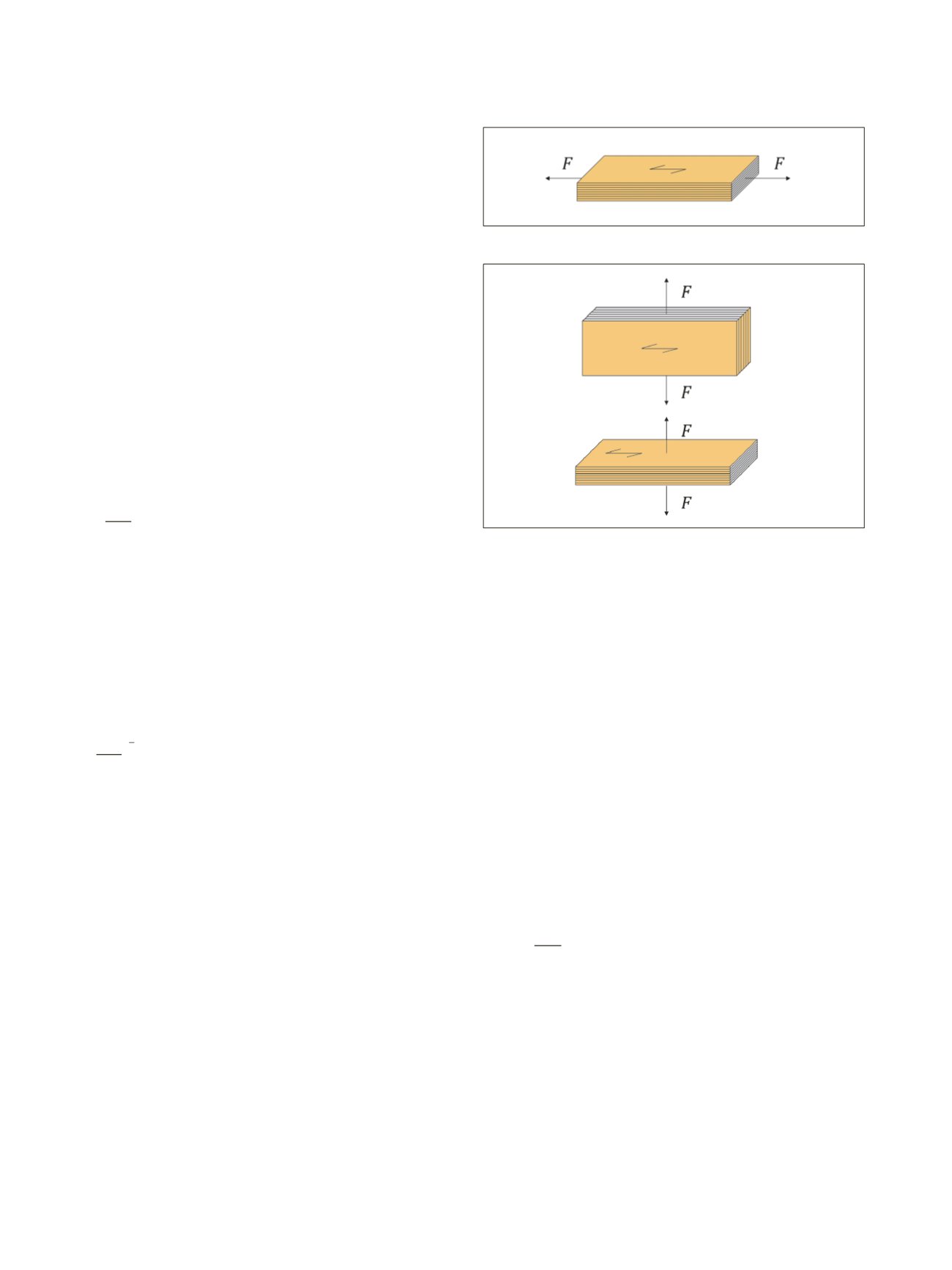
Figure 4.7.
Tension parallel to grain of surface veneers.
Figure 4.8.
Edgewise and flatwise tension perpendicular to the
grain of surface veneers.
The cross veneers of LVL-C improve the tension
strength perpendicular to the grain in edgewise direction
f
t,90,k
= 4-5 N/mm
2
is many times better than the strength of
LVL-P. This property is an advantage especially in suspended
connections and between main beams and secondary beams
or diagonal struts.
Tension strength flatwise perpendicular to the grain of
LVL-P and LVL-C is low and it is not recommended to design
a structure so that the stresses in this direction would become
critical. The strength value in this direction is normally not de-
fined in the DoPs for LVL products, but to have an idea of the
strength level,
f
c,90,k,flat
= ~ 0,2-0,3 N/mm
2
could be used for
estimations in predesign.
4.3.5 Compression parallel to the grain
The following expression shall be satisfied:
σ_(c,0,d)=F_(c,0,d)/A≤f_(c,0,d)
(4.12)
where
σ
c,0,d
is the design compression stress along the grain;
F
c,0,d
is the design compressive force;
A
is cross-sectional area of the member; and
F
c,0,d
is the design compression strength along the grain.
For LVL strength classes a separate, 20% higher
f
c,0,k
value
has been defined for service class 1 in Table 4.5 and 4.6. The
k
mod
factor of Eurocode 5 is similar in SC1 and SC2, but ma-
terial testing has shown compression strength values to be dif-
ferent in SC1 and SC2. The same phenomenon is also known
for other load-bearing wood products, but the strength values
t,0,d
=
t,0,d
≤
t,0,d
(4.9)
l
= �
300
�
2
≤ 1,1
(4.10) (EC5 3.4)
t,0,d
=
t,0,d
≤
t,0,d
(4.9)
l
= �
3000
�
2
≤ 1,1
(4.10) (EC5 3.4)
t,90,d
≤
t,90,d
(4.11)
,0,
=
c,0,d
≤
c,0,d
122
LVL Handbook Europe